For roofers · 12 min read
Websites for roofers: storms, insurance and proof
What a roofing site needs: the storm week, insurance work, photographs that prove the job, flat versus pitched, and guarantees people believe.
The storm week is the week your site earns its keep
Gales on a Tuesday night. From six on Wednesday morning the phone does not stop, and by Thursday you have forty calls and room for six. Every other week of the year your website is quietly answering questions. That week it is doing something harder: sorting a queue you cannot possibly serve, without making enemies of the people you turn down.
The way to do that is a dated line at the top of the home page, changed by hand when the weather turns. Something like: "Storm Wednesday. Booked up for make-safe until Monday. Quoting new work from the 20th." It costs you nothing and it stops four people in ten from ringing at all, which means you actually answer the ones who do. A number that rings out reads as a business in trouble. A number with an honest queue beside it reads as a business with more work than time.
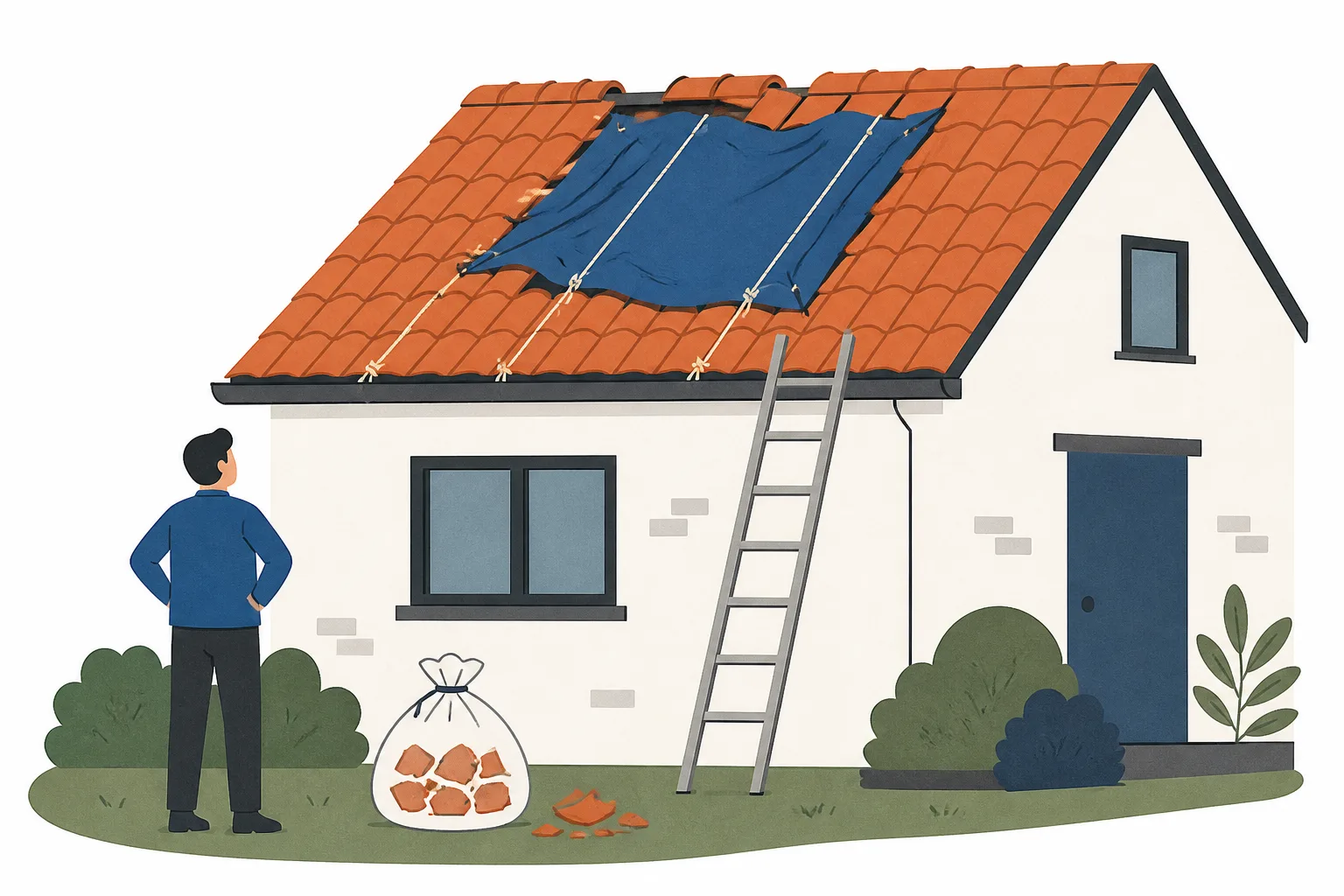
Split the two things you sell that week, because customers do not know they are different. A make-safe visit is a tarpaulin, a bagged-up pile of broken tile and a bill for a couple of hundred pounds. The repair is a separate job, later, with a proper quote. Say that on the page and the phone call gets thirty seconds shorter every time.
Then tell them what to do before you arrive. Buckets under the drips, the electric off in that room if water is anywhere near a light fitting, nothing moved off the ground until it has been photographed, and nobody up a ladder in a wind. It costs you a paragraph. It is the most useful thing on the site to the person reading it at half six in the morning.
Note. Write the storm line yourself, date it, and delete it when the queue clears. A permanent "24 hour emergency response" banner is a promise; a dated sentence is information, and information is what gets believed.
Insurance work: say exactly what you do and do not do
The second question after a storm is always the same. Will the insurance pay for it. Most roofing sites say nothing at all about this, so the question comes down the phone instead, forty times in a week, and every answer takes ten minutes.
Write the answer down once, and write it straight. Insurers treat sudden storm damage differently from gradual wear, and a lot of declined claims are declined because the ridge had been loose for six years and the wind only finished it. You cannot promise anybody a payout and you should not try. What you can do is describe the process, say what your report contains, and say who pays you and when.
Decide before you write it whether you actually want this work. Insurance jobs pay slowly, involve a loss adjuster who may want the scope cut, and sometimes need you to hold the cost of scaffolding for two months. Plenty of good roofers quote for the customer and let the customer deal with their insurer, and saying so plainly on the site is not a weakness. It is a filter.
- Whether you handle the claim, or supply a quote and report for the customer to submit.
- What the report contains: photographs, the likely cause, the scope, the cost — and whether you charge for producing it.
- Who you invoice, the customer or the insurer, and when payment is due either way.
- That the excess is theirs, so nobody is surprised by it at the end.
- That you cannot guarantee an insurer will pay, in one honest sentence.
- Advice to photograph the damage from the ground before anyone touches it.

Photographs, because nobody can see your work
A kitchen fitter has a kitchen. A plasterer has a wall. You have something twenty feet up that the customer will never look at, and that is the whole problem with selling roofing. Photographs are not decoration on a roofer's site. They are the only evidence the customer will ever have.
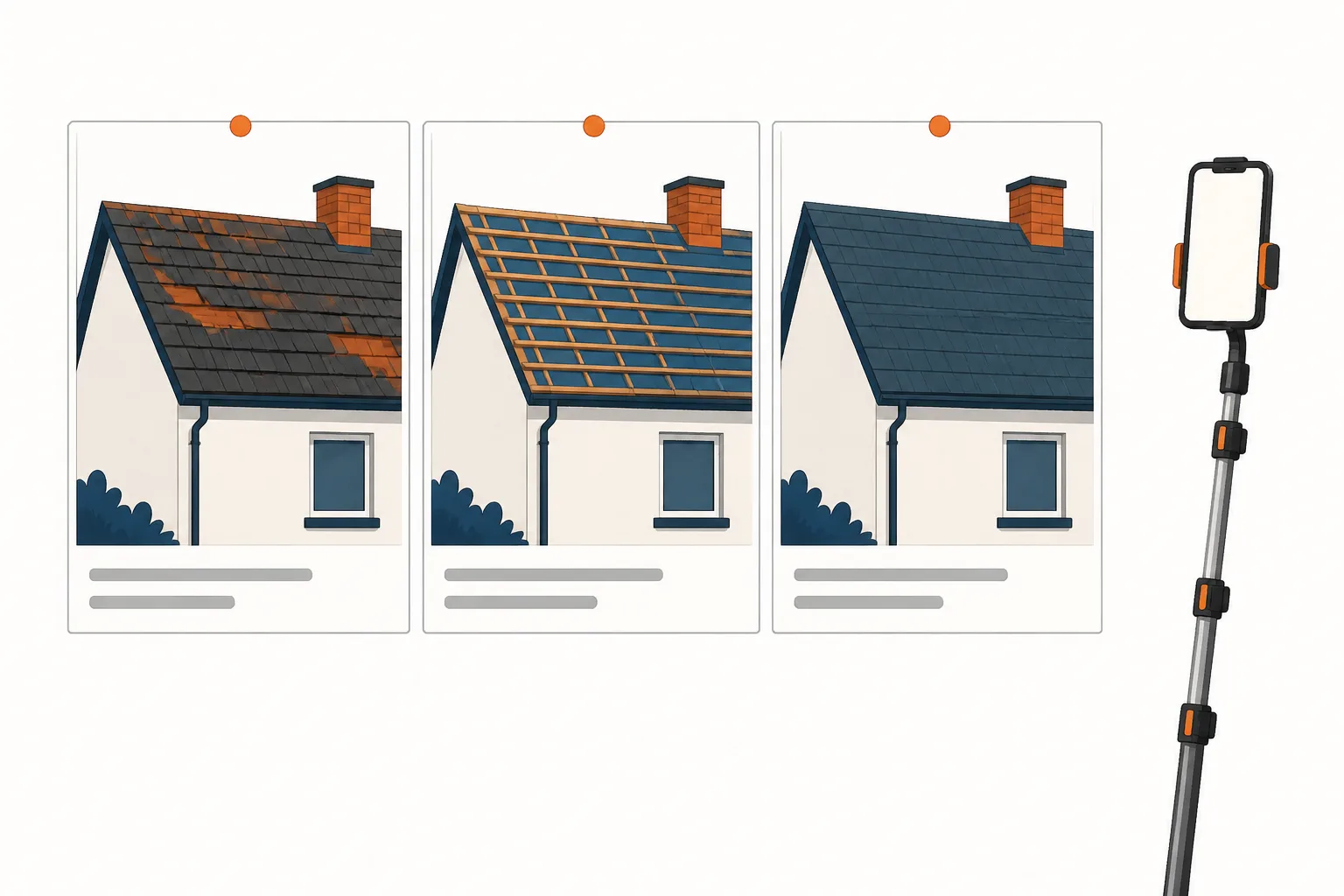
Take them in sets, not singly. The same elevation from the same spot before and after is worth more than ten glamour shots, because it is the pair a sceptical person can compare. Add a close-up of the actual fault so they can see what you saw — the cracked mortar bed, the slipped slate, the flashing that was never dressed into the brickwork. Add one from the roof mid-job with the felt and battens showing, because that is the part they are paying for and cannot otherwise verify. Finish with the scaffold gone and the garden swept.
Caption each set in a line: the roof type, the town, how long it took. "Reclaimed slate re-roof, Victorian terrace, Chorlton, four days." That sentence carries the town for search, the material for the customer who has been quoted the same thing elsewhere, and the timescale for the person wondering how long their house will be under a scaffold.
Do not use the stock photographs that come with every roofing template. Half of them are American asphalt shingle roofs with a colour of sky we do not get. People notice, and the thing they notice is that you had nothing of your own to show.
- The fault itself, close up, so the customer sees the reason for the bill.
- The same view before and after, from the same place.
- One mid-job shot with the deck, felt or battens visible.
- The finished ridge and verge, since that is where the next roofer will look.
- The site left clean, scaffold down, skip gone.
- A date on the set, so nobody wonders whether it is from 2014.
Flat and pitched are two different businesses
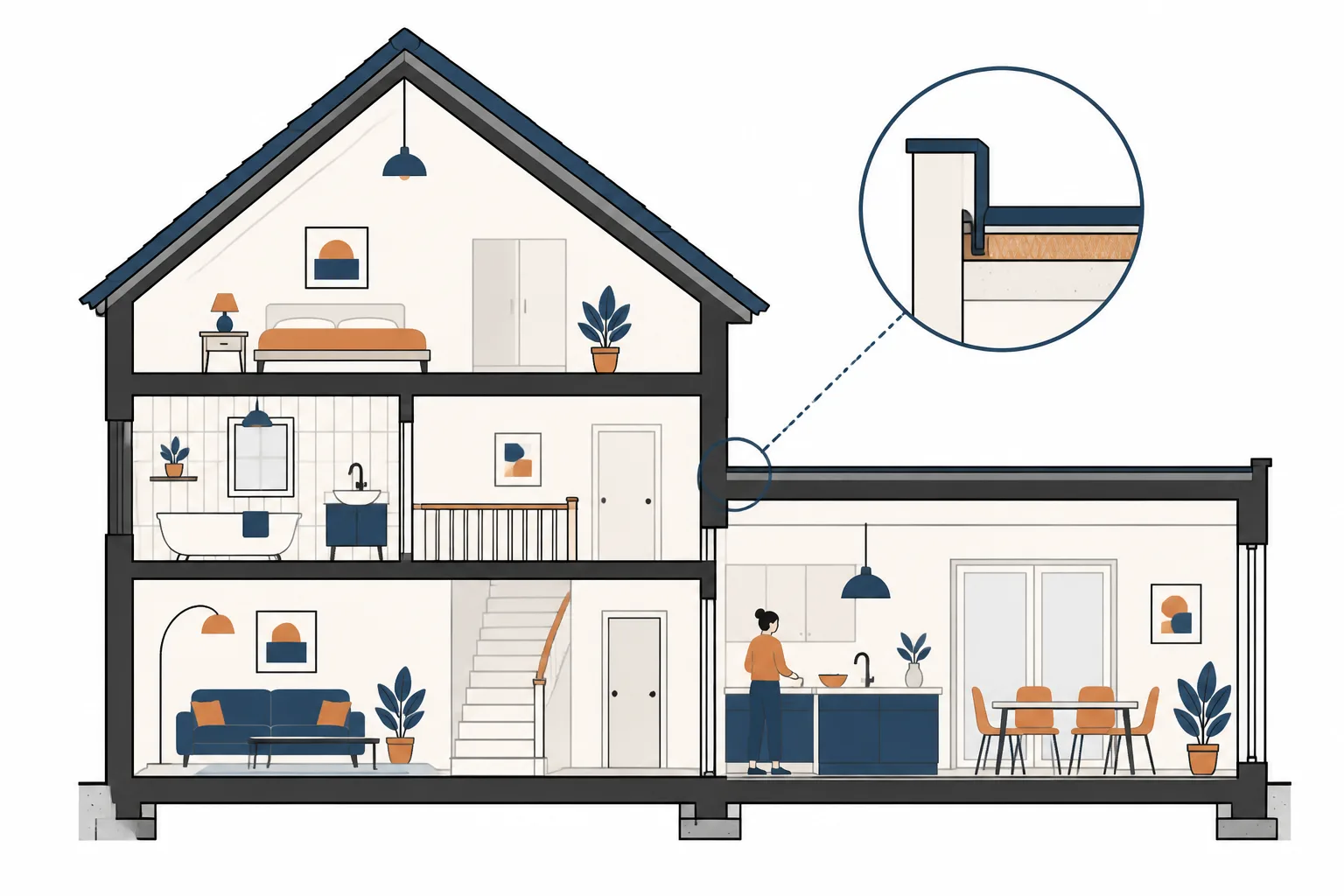
A pitched roof customer usually has a problem: a leak, a storm, or a roof at the end of its life. A flat roof customer usually has a project — an extension, a dormer, a garage — and has been given three conflicting opinions before they get to you. They also search differently. They type system names. "EPDM rubber roof cost", "fibreglass flat roof near me", "GRP or felt". If those words are nowhere on your site, none of those people can find you.
So name what you fit, and be specific about where each one suits. Then name what you do not fit, because a roofer who says "I do not touch asphalt" reads as someone who has thought about it, not someone turning down money.
On the pitched side, the same rule applies with different words: natural slate, reclaimed slate, concrete interlocking tile, clay plain tile, lead work, dry ridge. Mention that ridge and hip tiles are mechanically fixed to meet the current British Standard rather than bedded in mortar alone, and that if a neighbour's roofer only pointed the mortar back up, that is why theirs has moved again. It is a small technical point that tells a customer, in one sentence, that you are current.
| Flat roof system | Typical life | Where it suits |
|---|---|---|
| Torch-on felt, three layer | 15 to 25 years | Garages and outbuildings, tighter budgets |
| EPDM rubber | 20 to 30 years | Simple square roofs laid in one sheet |
| GRP fibreglass | 20 to 25 years | Balconies and anything that gets walked on |
| Single ply membrane | 20 to 30 years | Larger and commercial roofs |
| Liquid applied | 15 to 25 years | Awkward detail, pipes, upstands, patch repairs |
Note. Those lifespans assume the fall, the deck and the detailing are right. Say so on the page. Most flat roofs fail at an edge or an upstand years before the membrane in the middle is anywhere near finished.
Guarantees, and how to present one honestly
"10 year guarantee" sits in a yellow banner on half the roofing sites in the country and means, on its own, almost nothing. The customers worth having know that. Some of them have already had a guarantee from a firm that closed the following spring.
Three different things get called a guarantee and they are worth separating on the page, because separating them is itself the proof that yours is real. Then say the boring part out loud: how long, what it covers, what it excludes, whether it passes to the next owner, and who to ring. Put a sample certificate on the site as a picture if you have one.
Exclusions are not a weakness to bury. A guarantee that appears to cover everything is one nobody believes. Storm damage after the work is done, blocked gutters, moss left to build for five years, someone else's aerial fitter walking across your verge — write them down and the rest of the document starts reading as a real document.
- The length, and whether repairs and full re-roofs get different lengths.
- Whether it transfers if the house is sold, which sellers and buyers both ask.
- What voids it: gutters left blocked, other trades on the roof, alterations.
- How to make a claim, and how quickly you turn up.
- Whether it is registered with a scheme, and the certificate the customer receives.
| What it is called | Who stands behind it | What it actually covers |
|---|---|---|
| Workmanship guarantee | You | Faults in how it was fitted |
| Manufacturer warranty | The material maker | The material, usually only if registered on time |
| Insurance-backed guarantee | An insurer, through a scheme | Your workmanship cover if you stop trading |

Prices, and the scaffolding nobody budgets for
Roofers are asked what a new roof costs more often than anything else, and answer it less often than any other trade. The objection is fair — every roof is different — but silence does not protect you. It sends the customer to a competitor who did put a range up, and it fills your week with quotes for people who thought a re-roof was two thousand pounds.
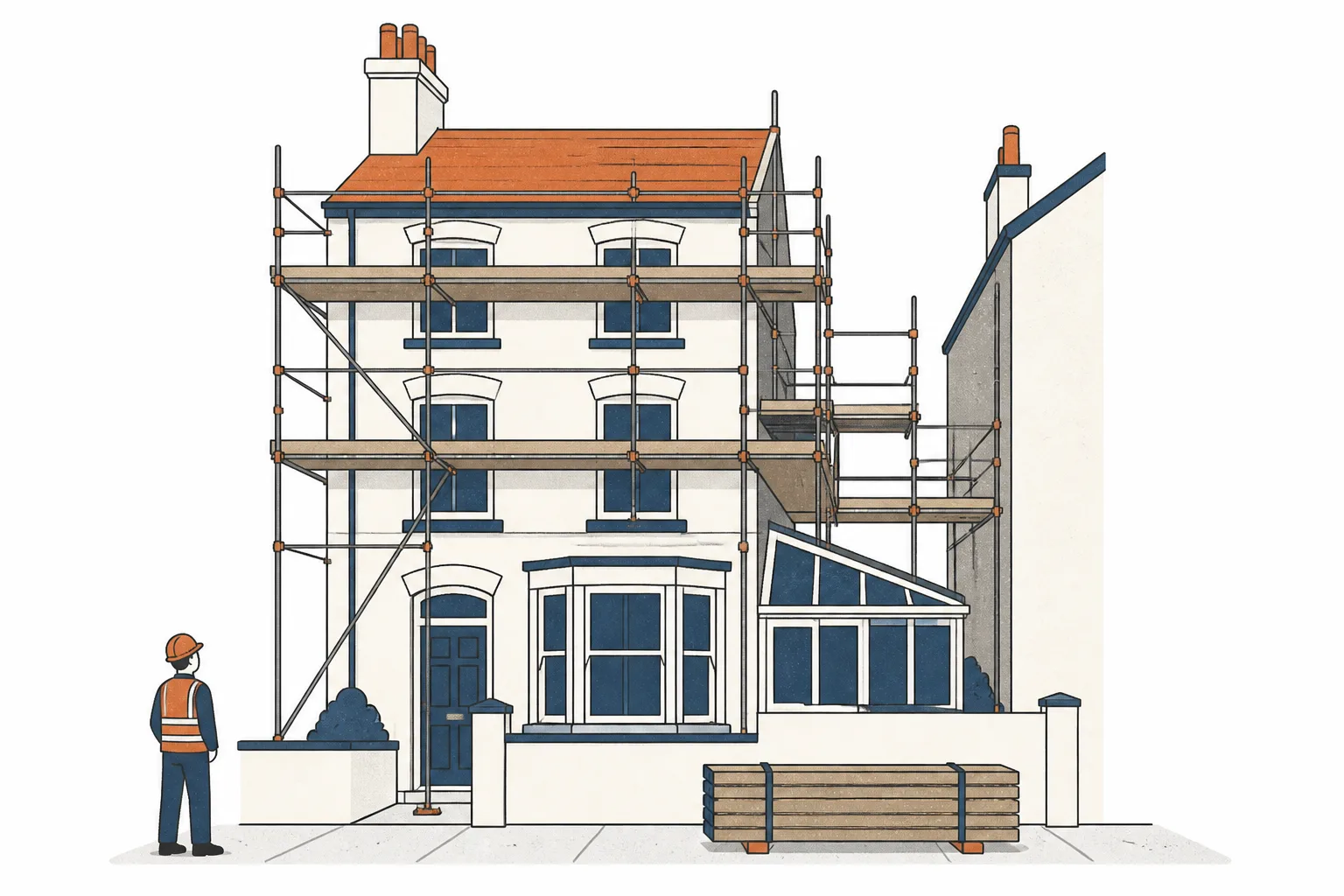
Publish ranges and name the variables. Access is the one customers never see coming. Scaffolding is usually priced separately, by elevation and by how long it stands, and a three-storey terrace with a conservatory in the way is a different number from a bungalow you can get all the way round. Say that. A customer who understands why the quote moved does not argue with it.
The figures below are the sort of ranges seen around the UK and they move a long way by region and by access. London and the South East sit at the top. Work out your own numbers, put those on the site, and mark them clearly as ranges.
| Job | Typical range | What moves it |
|---|---|---|
| Slipped or missing tiles, repair visit | £150 to £400 | Whether a ladder reaches or a tower is needed |
| Ridge re-bedding or dry ridge, terrace | £500 to £1,500 | Length of ridge, scaffold, tiles reusable or not |
| Chimney repointing and new flashing | £400 to £1,200 | Height, condition of the stack, lead weight |
| Flat roof, per square metre fitted | £80 to £160 | System, insulation, condition of the deck |
| Re-roof, three-bed semi, concrete tile | £5,000 to £9,000 | Battens, felt, access, whether the timbers are sound |
| Re-roof in natural slate | £9,000 to £20,000 | Slate type, pitch, detailing, scaffold time |
| Scaffolding, semi-detached, standard hire | £600 to £1,500 | Elevations, road licence, weeks standing |
Note. Write "from" and "typical" and mean them. A headline price that no real job ever comes in at does more damage than publishing nothing, because the customer finds out at the quote and decides you were being clever.
Being visibly not the bloke who knocked on the door
Roofing carries a reputation the rest of the trades do not have to answer for. Almost every customer over sixty has heard the line about the lads who were working up the road and happened to notice the ridge. Your website has to be plainly, obviously, a different kind of business, and it can do that in about six sentences.
Give a name and a face. Say where you are based, even if you work from a yard and a van, and say how long you have been doing it. Put the company number and the public liability cover with the amount. If you belong to a trade body, name it and give the membership number so it can be checked. If you do not belong to one, say nothing rather than inventing a badge.
Then set out how you quote and how you take money, because that is where the doorstep trade gives itself away. Written quotes, itemised, no discount that expires on Friday, and no cash before the scaffold is up. One plain sentence about your deposit policy will win you more work than any amount of writing about quality.
- The name of the person who will actually turn up.
- Where you are based, and how long you have been trading.
- Company number if you are a limited company, and public liability cover with the figure.
- Trade body membership with the number, or nothing at all.
- How you quote: written, itemised, and how long the price holds.
- When you want paying, and what you ask for before starting.

Common questions
- Should I take on insurance work at all?
- Only if you can wait for the money and cope with a loss adjuster trimming your scope. Many roofers do better quoting for the customer and letting them claim. Whichever you choose, say it on the site so the wrong leads stop arriving.
- Can I put drone photos of roofs on my site?
- Yes, but flying one commercially in the UK means registering with the CAA and following the rules on flying near people and other people's property. A telescopic pole with a phone on the end gets you most of the same shots with none of the paperwork.
- I only do flat roofs. Should the site still say roofer?
- Yes, because that is what people search, but lead with flat roofing and name the systems you fit. A page that says EPDM, GRP and single ply will be found by people who have already been told those words by someone else.
- How long a guarantee should I offer?
- One you could honour in year nine. Ten years on workmanship for a full re-roof is common and a year or two on a small repair is honest. The length matters far less than writing down what it excludes.
- Do I need a page for every town I cover?
- No. Six real ones beat forty with the name swapped. Write about the roofs you actually meet there, the slate on the older terraces or the concrete tiles on the eighties estate, and the page reads like someone who has been.