For gardeners and landscapers · 12 min read
Websites for gardeners: seasons, rounds and proof
What a gardening or landscaping site needs: the spring rush, maintenance rounds against one-off builds, before-and-after photographs, and where the waste goes.
The season runs the site, not the other way round
The phone starts somewhere in the last week of March and does not stop until the end of July. By the second week of April you are booking four weeks out and turning people away. Then the clocks go back, the leaves come down, and January is three quotes and a lot of paperwork. Almost every gardening website is written as though every month is May.
So the site has two jobs, and they swap over twice a year. In spring it should be politely turning work away and building a list for the autumn, because a maintenance round is worth more than the job you cannot fit in anyway. In winter it should be selling the work that can actually be done in winter, to the people who assume you have gone quiet.
The mechanism for both is one dated sentence near the top of the home page, changed by hand four times a year. Something like: "Booked up for regular maintenance until September. Taking names for the autumn round now. Hedge and fence work available from October." That sentence stops the calls you cannot serve, keeps the ones you can, and reads as a business with more work than time rather than one that has stopped answering.
Winter work is real work and most gardeners undersell it on their site. Hedges cut once the nesting season is over. Pruning, turfing, fencing, clearance, leaf and gutter work, path repairs, and the design and groundwork for a build that goes in come March. Give those their own lines on the services page rather than a footnote, because in November they are the whole business.
Note. Bird nesting season runs roughly March to August, and destroying an active nest is an offence. Say on the hedge page that you check before you cut and will come back if you find one — customers who did not know will thank you for it, and the ones who did will trust the rest of the page more.
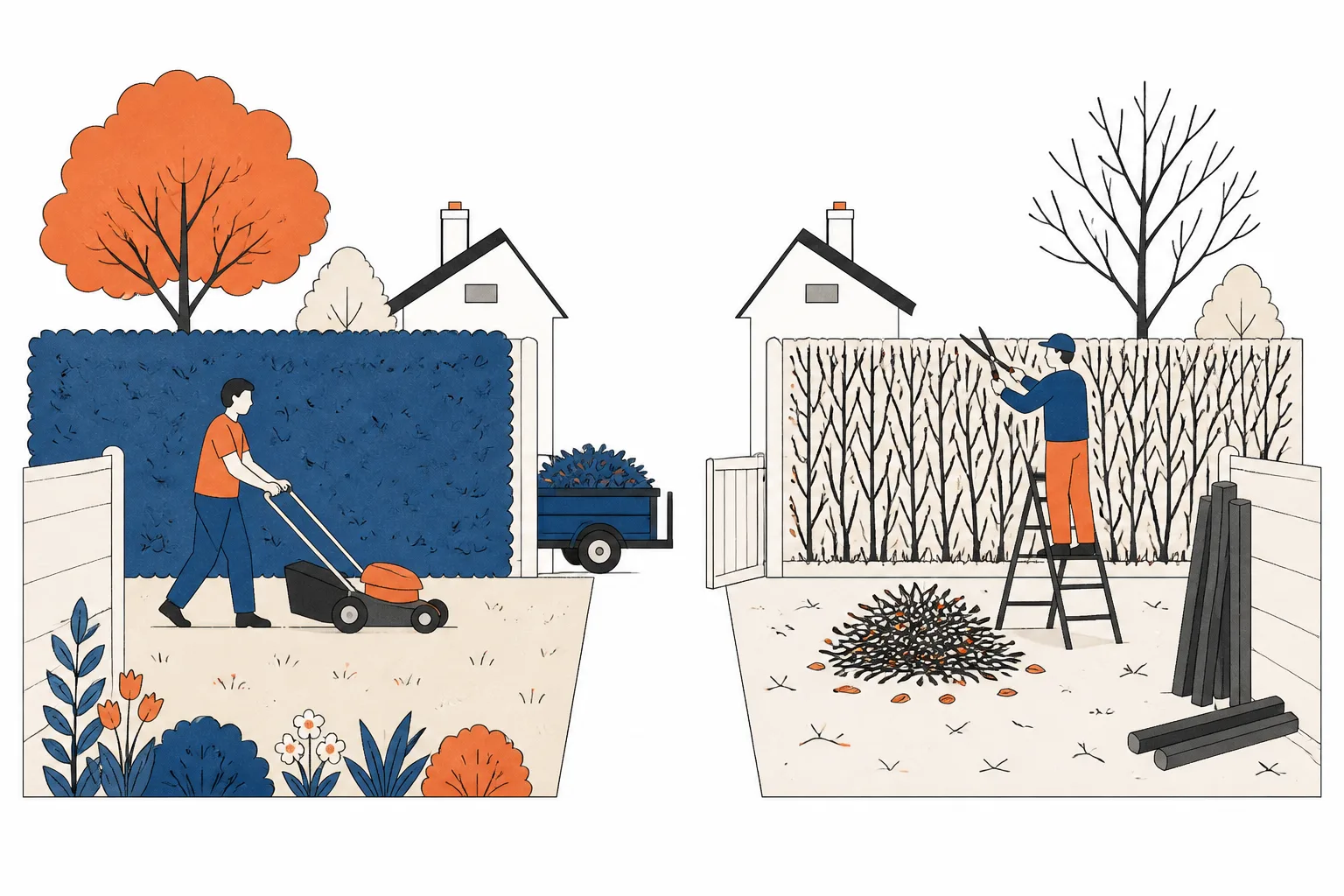
Maintenance and projects are two businesses on one site
The person looking for a fortnightly cut and the person spending nine thousand pounds on a patio are not the same customer and they are not making the same decision. One is buying a problem they never have to think about again. The other is about to hand over the price of a car to somebody they found on their phone, and needs a great deal more convincing.
Most gardening sites collapse both into a single services page with a bulleted list — grass cutting, hedge trimming, turfing, fencing, patios, decking — which reads like a leaflet through the door and answers neither person. Split them. Two pages, written for two readers, linked from the home page as two separate offers.
The maintenance page is not about your skills. It is about what happens on a Tuesday. How often you come, whether it is the same day each time, whether anyone needs to be in, what happens to the clippings, what happens when it rains, and what happens in December. Answer that lot in plain sentences and you will close people who never ring at all.
The project page is the opposite: it is almost entirely proof. Photographs, a description of how a build actually runs from first visit to final tidy, a rough price range, and how long you will be in their garden with a digger. A homeowner will forgive a high number. They will not forgive not knowing whether their garden is a building site for one week or five.
- How often you visit, and whether it is a fixed day.
- What a standard visit includes — and what it does not, so nobody expects the borders done for the price of a cut.
- Whether they need to be home, and how you get to the back garden if not.
- Where the green waste goes and who pays for it.
- What happens in bad weather: do you skip, or come the next dry day.
- How winter works — fewer visits, and whether the monthly figure changes.
- How to stop: notice period, in one sentence, with no small print.

Contracts, standing orders, and saying what it costs
The best thing about a maintenance round is not the money per visit, it is that the money keeps arriving in February. Twelve equal payments across the year, more visits in summer and fewer in winter, evens out the worst part of the trade. Say that on the page in exactly those terms, because the question in the customer's head is whether they are paying in January for nothing, and if you do not answer it they will simply not sign up.
Give the year in numbers rather than adjectives. Something like: around twenty-four visits a year, fortnightly from March to October, monthly through the winter for tidying and pruning, one figure a month by standing order. That is a contract a normal person can hold in their head, and it stops the conversation where they ask you to skip December.
On pricing, a single number is a trap and silence is worse. A range with the reasons beside it filters out the leads you did not want and reads as somebody who has done this before. The numbers below are broad UK ranges and move a long way with region, access and how much of the garden is border rather than lawn — London and the South East sit at the top of them, and a job with no side access can sit above them entirely.
| What they are buying | Typical range | What moves it |
|---|---|---|
| Regular visit, small suburban garden | £35–£60 a visit | Size, frequency, who takes the waste |
| Maintenance by standing order | £80–£180 a month | How much is border and hedge, not lawn |
| One-off clearance, two people, one day | £250–£450 | Access, and tipping fees on top |
| Hedge cutting, day rate | £200–£400 | Height, waste volume, whether a platform is needed |
| New patio, small back garden | £3,000–£9,000 | Materials, levels, getting a digger in |
| Full design and build | £15,000 upwards | Everything — quote it properly |
Note. Put the tipping cost where the customer can see it before they ring. "Green waste taken away and disposed of legally, charged at cost, usually £30 to £60 a load" ends an argument that otherwise happens in somebody's driveway.

Before and after photographs do the selling
There is no more persuasive thing a gardener can put on a website. Everyone already knows what a neglected garden looks like and what a finished one looks like, so the pair of pictures needs no explanation and survives being seen on a phone screen at arm's length. Six good pairs will out-sell two thousand words about your attention to detail.
The whole trick is standing in the same place twice. Take the before shot before you unload anything, because a bag of tools and an open tailgate in the corner of the frame quietly tells the reader the picture is staged. Note where you stood — the back door, the corner of the patio, the side gate — and go back to that exact spot at the end. Hold the phone the same way round both times; a portrait before against a landscape after is unusable and you will not notice until you are sat at the laptop in the evening.
Be honest with the light. An after shot in July sunshine against a before shot in February drizzle is the weather doing the work the garden should be doing, and readers register it even if they cannot say why. If you can, the strongest after is the one taken a season later, once the planting has filled in and the turf has knitted. Ask the customer when you finish whether you can come back in a year with a camera. Most say yes.
Then caption them. One sentence each: what it was, what you did, how long it took, and roughly what it cost. A photograph gets looked at; a caption is what turns it into a phone call. Name the town and never the street, and ask before you publish anything that shows a house — most people are pleased to be asked, and the one who says no would have made a complaint instead.
- Same spot, same height, same orientation, before and after.
- Before shot first, prior to unloading the van.
- Wide shot for the transformation, one close shot for the workmanship.
- Watch the background — neighbours' windows, registration plates, the kids' trampoline next door.
- A mid-job photograph on big builds: sub-base, edging, drainage. It proves the part nobody can see afterwards.
- A caption with the town, the work and a rough cost.
- Permission from the customer before it goes on the site.

Waste licences, and why customers quietly care
When somebody asks where the rubbish goes, they are not making conversation. They have read about a fly-tipped pile of garden waste on a country lane being traced back through an envelope to the householder who paid a man in a van to take it away. Householders have a legal duty of care to check that whoever removes their waste is registered to do it, and that duty does not transfer to you just because you took the money.
If you carry waste produced by somebody else — which is every gardener with a trailer of hedge cuttings — you need to be a registered waste carrier. In England that is an upper tier registration with the Environment Agency, renewed every three years; in Wales it is Natural Resources Wales, in Scotland SEPA, and in Northern Ireland NIEA. The registers are public and searchable, so the number on your website is a claim anyone can check in about a minute. That is precisely what makes it worth publishing.
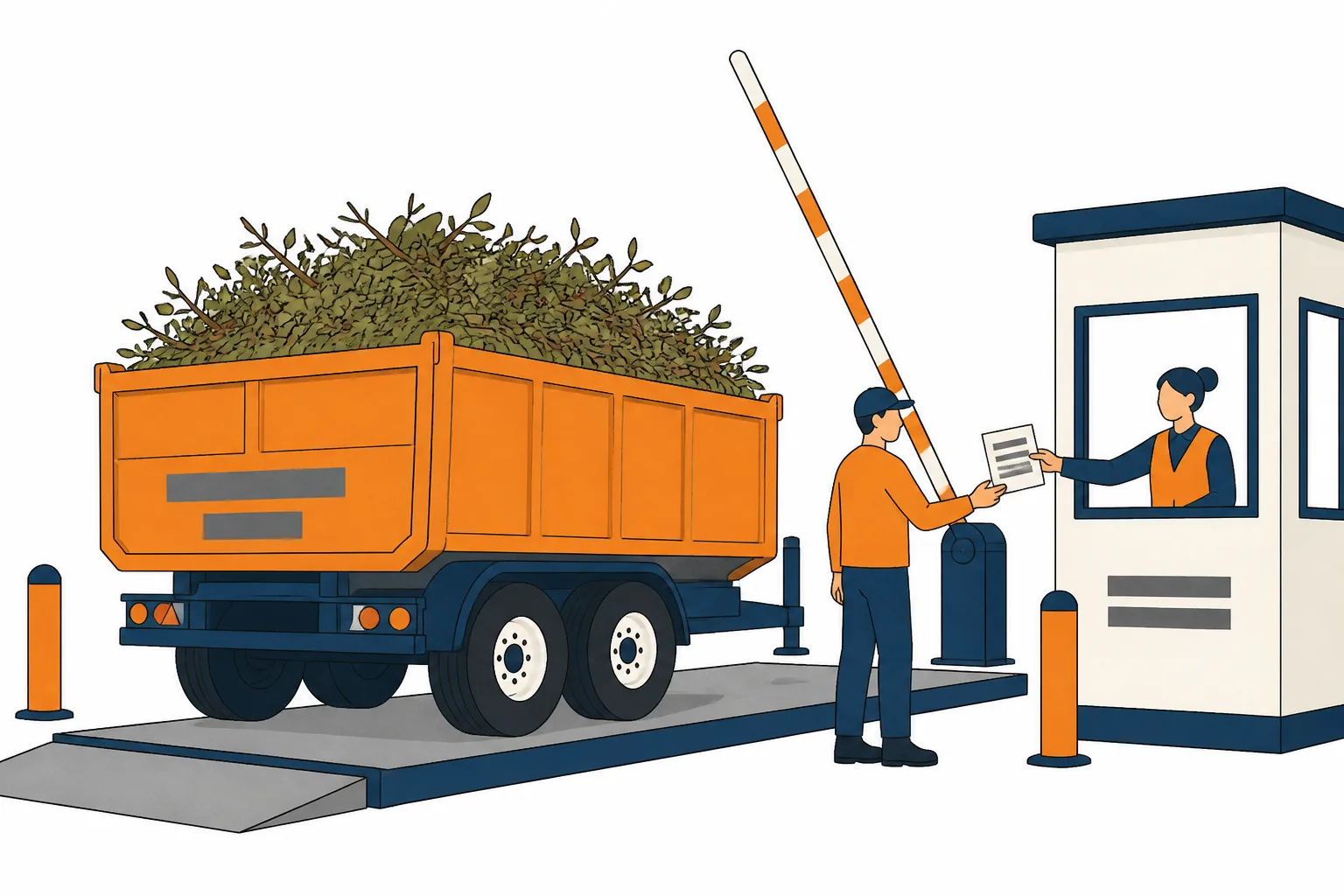
The tip is the other half of it. A household waste recycling centre is for householders, and turning up with a trade load of green waste will usually get you turned away or charged. Trade green waste goes to a licensed transfer station or composting site, you pay by weight, and you come away with a transfer note or a weighbridge ticket. Keep them. They are the paperwork that proves the chain, and on a commercial contract you will eventually be asked for one.
None of this needs a page of its own. Two sentences on the maintenance page and the registration number in the footer covers it, and it separates you from the cheaper quote the customer is holding in their other hand.
- Your waste carrier registration number in the footer of every page (England's begin CBDU).
- Which regulator you are registered with, so people know where to check.
- One line saying green waste goes to a licensed site and you keep the transfer notes.
- Whether disposal is included in your price or charged at cost, stated plainly.
- That you are insured — public liability, with the figure, since a lot of gardening happens next to greenhouses and parked cars.
Note. Do not write "fully licensed and insured". It is the phrase every unlicensed operator uses. Write the registration number and the cover amount instead, and let the reader verify them.
The round is the business, so put it on the map
A gardener's profit is decided by driving. Ten minutes between jobs and you fit five in a day; forty minutes and you fit three, for the same fuel and the same hours. A plumber can chase work across a county. You cannot, and a website listing every town within an hour of your house will bring you exactly the leads you should be refusing.
So write the areas page as a round rather than a radius. "Tuesdays and Wednesdays in Chesham, Amersham and Little Chalfont. Thursdays in Berkhamsted." That is more useful to a customer than a list of thirty place names, it is more honest, and it makes the ask obvious to anyone standing slightly outside it: get two neighbours together and you become worth the drive. Say that out loud on the page — a street with three gardens on it is the cheapest work you will ever get.
For being found at all, the ordinary local rules apply and they are not complicated. Write the town names out as words, because that is what people type. Fill in a Google Business Profile with the same details as the site and load the before-and-after photographs onto it. Keep the business name, address and phone number identical everywhere they appear.
Last, the contact form. Ask for four things and nothing else: the postcode, roughly how big the garden is, whether it is regular maintenance or a project, and a photograph. That last one is the difference between a quote given from the sofa and a forty-minute round trip to look at a lawn. Put the word "photo" on the button and most people will attach one.

Common questions
- Should I put a price for a regular cut on the site?
- Put a range and say what changes it — size, frequency and whether you take the waste. A flat number gets quoted back at you on a garden twice the size you imagined, and no number at all means you spend your evenings answering the same message.
- What do I put on the site when I am booked up in May?
- A dated line saying you are full for maintenance until a given month and taking names for the autumn round. It stops the calls you cannot serve without making enemies, and a waiting list in June is next year's income.
- Do I need a waste carrier licence just for grass and hedge cuttings?
- If you are carrying waste that your customer produced, yes — in England that is an upper tier registration with the Environment Agency, with the equivalent regulator elsewhere in the UK. Green waste is not exempt for being biodegradable.
- I never remember to take the before photos. What now?
- Put a note on the dashboard of the van, and take the shot before the tailgate opens. Until you have a stock of pairs, a single strong after shot with an honest caption still works — just do not label an ordinary tidy as a transformation.
- All my work comes from word of mouth. Is a site worth it?
- Word of mouth still ends with someone typing your name into a phone to see if you look real. A site with photographs, a covered-areas list and a licence number turns that check into a call, and it also lets you say no politely in May.