For garages · 12 min read
Websites for garages and mechanics
MOT reminders, courtesy cars, the makes you specialise in, what a diagnostic fee buys, and whether people should book online or ring you.
What a driver checks before booking a garage
A car problem is a diary problem. Whatever is wrong with the car, the thing filling the customer's head is how they get to work on Thursday and whether they can pick the kids up. Most garage websites answer none of that and lead instead with a photograph of a ramp.
The other thing in their head is the fear of being had. Almost everybody has a story about a garage that quoted one figure and charged another, or found three extra faults once the car was in the air. That story is the reason they are reading your site at all instead of driving to the nearest place with a sign.
So the site has two jobs. Prove you do the specific thing their car needs, and take the diary problem off their hands. A garage that says plainly what an MOT costs, that it can be done on Saturday morning, and that there is a car they can borrow, has already answered more than most of the competition.
- The job named properly — "cambelt and water pump", "DPF cleaning", "clutch replacement" — not "all mechanical repairs".
- Whether you can look at their make, especially if it is German, French or a Land Rover.
- What it costs, or what the hourly labour rate is, with VAT made clear.
- How they get home: courtesy car, collection, a lift, or a waiting room with a kettle.
- How soon you can take it in, and whether Saturday counts.

MOTs, and the reminder that keeps the customer
The MOT is the front door. It is the one job on the calendar that every car owner in the country has to think about once a year, it brings the car onto your ramp, and it is where most of the servicing and repair work that follows comes from. A garage site that buries it under a services dropdown is throwing away the easiest page it will ever have.
Two facts are worth spelling out on that page because customers get them wrong constantly. The first is that the fee is capped: DVSA sets a maximum a testing station may charge, and plenty of garages charge under it or fold the test into a service price. The second is that a car can be tested up to a month minus a day before the current certificate runs out and keep the same expiry date. People assume testing early costs them the difference. It does not, and saying so brings bookings forward into your quieter weeks.
Then there is the reminder. DVSA runs a free service that texts or emails a driver a month before the test is due, which is genuinely useful and sends them absolutely nowhere in particular. Your own reminder is different: it arrives with your name on it and a link that books a slot. That is the single highest-value thing a small garage can wire into a website, and it needs almost nothing — the registration, the expiry date, and a text a month out with a booking link in it.
If you offer a free retest inside the usual window after a fail, say so on the page and say what counts. It is a common source of arguments and a very cheap one to prevent.
| Class | Vehicle | Maximum fee |
|---|---|---|
| 1 and 2 | Motorcycles, with or without sidecar | £29.65 |
| 4 | Cars and vans up to 3,000kg, up to 8 seats | £54.85 |
| 4 | Motor caravans | £54.85 |
| 7 | Goods vehicles 3,000kg to 3,500kg | £58.60 |
Note. Those are the maximum fees a testing station may charge, not what you have to charge. Check the current figures on gov.uk before publishing them, and put a review date on the page — a site quoting last year's cap looks careless to exactly the customer who checked.
Courtesy cars, collection, and the lift to the station
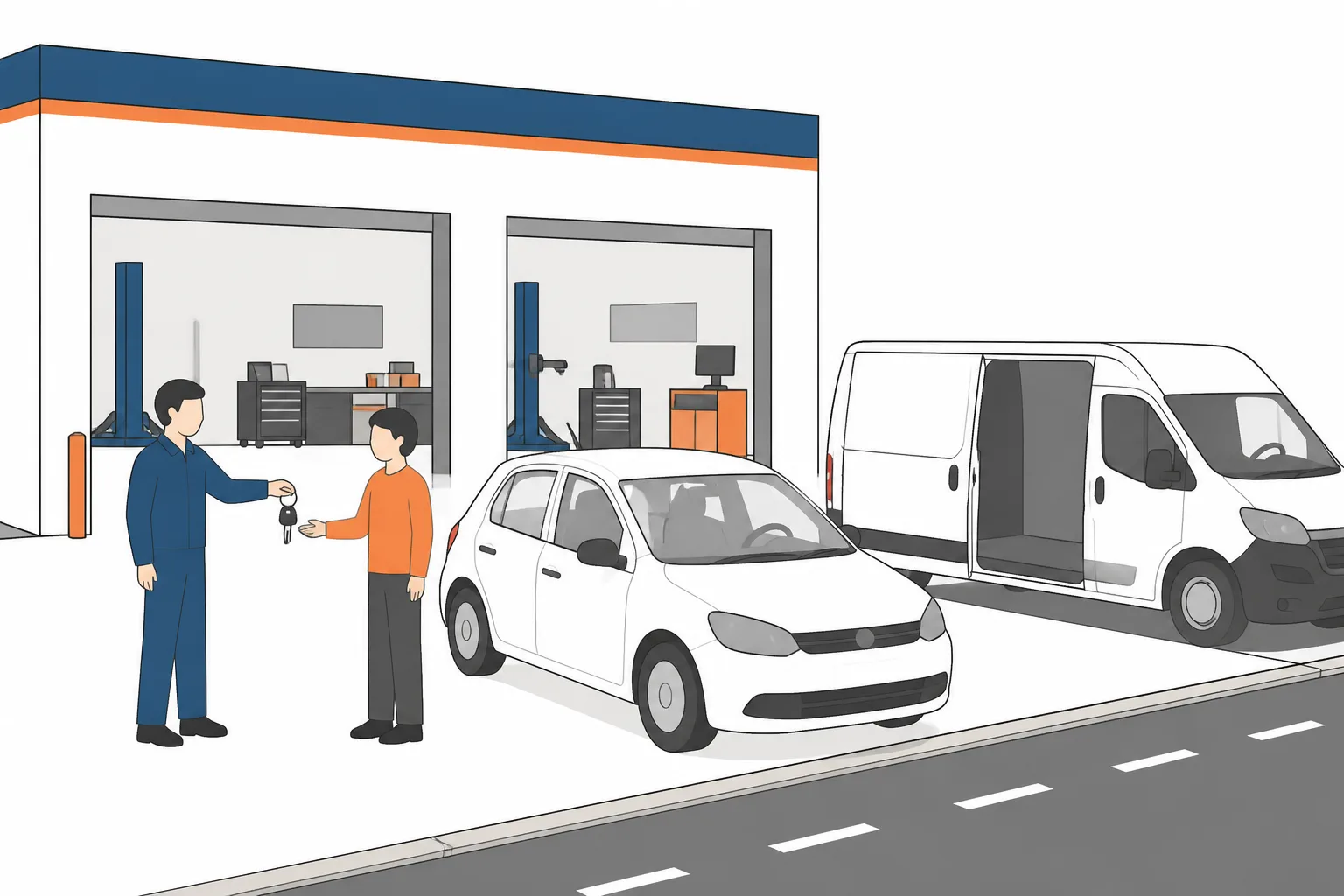
This is where independent garages beat main dealers and mostly forget to mention it. A dealer has a fleet and a process. You have two cars out the back, a van, and the willingness to drop someone at the station. Written down properly, that reads better than the fleet.
The problem is that "courtesy car available" answers nothing. The customer wants to know whether it costs anything, whether they are insured on it, whether they need to book it in advance, and whether they will be handed a keys-and-goodwill arrangement or something with a form. Every unanswered one of those is a phone call you have to take, and about half of those calls never happen because the person booked somewhere clearer instead.
Collection and delivery is worth its own line too. For a customer who works away from home, a garage that picks the car up off the drive at eight and returns it by five is not competing on price at all. Say which postcodes you will come out to and what the cut-off is.
- Whether the courtesy car is free, and if not, what it is per day.
- The insurance position — who is covered, the excess, and any minimum driver age.
- That it must be booked when the job is booked, if that is true.
- Fuel policy, in one sentence, so nobody is surprised at handover.
- Collection and delivery: the postcodes, the cut-off time, and whether it costs.
- The alternatives — a lift to the station, a courtesy bike, a waiting room with wifi and somewhere to work.
Note. If you only have one courtesy car, say so and say it goes on a first-come basis. Honest scarcity gets people booking earlier. Vague availability gets you a complaint on the morning.
Specialisms by make, and the warranty question
Most independent garages will take anything through the door, and most of them therefore write "all makes and models" on the website. It is true, and it is the least persuasive sentence available. Somebody with a 2019 Golf with a DSG box is not searching for a garage that does everything. They are searching for someone who has seen their gearbox before.
Name the makes you are genuinely strong on and say why — the diagnostic software you have, the specialist tooling, the fact you have done thirty of that engine's timing chains. A page called "BMW servicing in Chesterfield" that talks about the actual known faults on the actual engines will out-earn a generic services page by a distance, and it costs you an afternoon to write.
Then answer the warranty question, because it stops more people booking with an independent than price ever does. Under the UK block exemption rules a car in its manufacturer warranty can be serviced by an independent garage without invalidating that warranty, provided the work follows the manufacturer's schedule and uses parts of matching quality, and the service record is filled in properly. Say that plainly, say you stamp the book or update the digital record, and say you use OE or OE-matching parts. That paragraph converts.
The same logic covers hybrids and electric cars. If someone in the workshop holds the high-voltage qualifications, that is a page, not a bullet point — the number of EVs coming out of warranty is climbing and the number of independents willing to touch them is not.
- The makes you specialise in, each with a page and the jobs you see most on them.
- Diagnostic equipment by name, including any manufacturer-specific software.
- Cambelt and chain intervals for the engines you know well, with a price range.
- Whether you can service a car under warranty, and how the record gets stamped.
- Hybrid and EV work, and who is qualified to do it.
- Anything you will not touch, so nobody wastes a journey.

Diagnostics, and explaining what the fee buys
The engine management light is the most searched-for problem a garage deals with and the worst understood. The customer's model of it is simple: you plug in a machine, the machine says what is wrong, and that should be free or nearly free. Half the trade's arguments start there.
So use the page to reset the expectation before they arrive. A code tells you which circuit is unhappy, not which part has failed. The work is the road test, the live data, the wiring checks and the elimination — an hour or two of someone's time, and occasionally more. Charge for it, publish the charge, and say what happens to it if you go on to do the repair. Most garages that publish a diagnostic fee also say it comes off the bill if the work is authorised, and that sentence is doing most of the selling.
A typical independent charges somewhere in the region of £45 to £90 for the first hour of diagnostic time, higher in London and higher again for a make requiring dealer-level software. Those are ranges you will see quoted rather than a recommendation — publish your own, with a date beside it.
One more thing belongs on this page: what you do when the fault is intermittent. Saying that some faults need the car back when it is doing it, and that you will be honest rather than guess at parts, is a competitive advantage. It is the exact opposite of the story the customer is afraid of.
Note. Never promise a fixed price to fix a warning light. Promise a fixed price to find out, then a written quote before anything is replaced. That is the deal a nervous customer is looking for and almost nobody writes it down.

Booking a slot or ringing you
Garages fall into two camps on this and both are right about something. The book-online camp is right that a good share of bookings are made outside working hours, from a sofa, by someone who does not want to talk to anybody. The phone camp is right that a diary filled by strangers online is a diary full of jobs you cannot do on the day promised.
The way through is to split the work. Predictable jobs with a known duration can be booked straight into a slot. Anything where the time depends on what you find should come in as a lead — a form that collects enough for you to ring back with a real answer rather than a form that promises Tuesday at ten.
Whichever route the visitor takes, the form needs the registration. From the reg you get the make, model, engine and MOT history, which means you can quote properly instead of playing twenty questions on the phone. Ask for mileage too, and let them describe the noise in their own words. "Grinding at the front when I brake" is more useful than any dropdown you could build.
And keep the phone number at the top of every page, tappable. A driver on a hard shoulder is not filling in a form. The two things are not in competition; they serve different moments.
| Job | Route | Why |
|---|---|---|
| MOT | Book a slot | Fixed length, fixed price, easy to schedule |
| Interim or full service | Book a slot | Known duration once you have the reg |
| Brake pads and discs | Book a slot | Priced from the reg, done in a morning |
| Warning light or noise | Contact form, then ring | Time unknown until it is looked at |
| Clutch, cambelt, gearbox | Contact form, then ring | Needs a quote and a parts lead time |
| Breakdown or won't start | Phone only | Nobody fills in a form at the roadside |
The pages worth building, and the proof on them
Six or seven pages covers most garages. Build them around the work you want more of, not everything you are able to do, because the site brings back more of whatever it describes best. If servicing pays better than MOTs, the servicing page should be the better page.
Proof, for a garage, is not a stock photograph of a spanner. It is the ramp with your name on the wall, the technician who has been there eleven years, the diagnostic kit on its trolley, and a review that mentions a specific car and a specific problem. Reviews matter more here than in almost any trade, because the customer is trying to establish honesty and cannot judge the work themselves. Ask for them at handover, while the relief is fresh.
Put your labour rate on the site. It is the number every caller is circling and the one most garages withhold. Publishing it filters out the people who were only ever going to price-shop, and it reads as confidence to everyone else.
- MOT — price, what the test covers, the early-test rule, the retest policy.
- Servicing — interim and full, what is in each, priced by engine size.
- Diagnostics — the fee, what it buys, and what happens to it if you do the work.
- One page per make you specialise in.
- Repairs you want more of — clutches, cambelts, brakes, air conditioning.
- Courtesy cars and collection, with the conditions written out.
- Areas covered, with the towns and postcodes spelled out.
Note. Photograph the workshop on a normal Tuesday with the doors open, not after a deep clean. Customers are not looking for a showroom. They are looking for somewhere busy, tidy enough, and real.
Common questions
- Should I put my labour rate on the website?
- Yes. It is the first thing on the phone call anyway, and hiding it only invites the comparison you were avoiding. Publish it with VAT stated and a date beside it so you can raise it without argument.
- Is online booking worth it for a small garage?
- For MOTs and servicing, yes — a real share of those get booked in the evening when nobody can ring you. For diagnostics and bigger repairs, let the contact form collect the registration, then ring back, so you are not promising a slot before you know the job.
- Can I service a car that is still under manufacturer warranty?
- Yes, provided you follow the manufacturer's service schedule, use parts of matching quality and complete the service record. Say so on the site in plain words, because plenty of drivers believe they are tied to the dealer and never think to ask.
- How do I get customers to come back for the next MOT?
- Take the registration and the expiry date at the counter, then text a month before with a booking link. DVSA's free reminder tells them the test is due; yours tells them where to have it done.
- My work is all word of mouth. Do I need a site at all?
- The recommendation almost always ends in a search. Someone is given your name, types it into their phone in the car park, and decides from whatever appears. The site is what decides that moment rather than leaving it to chance.