For plasterers · 12 min read
Websites for plasterers: builders or homeowners
Where the work comes from decides everything: a site does little for builder-fed contract work and a great deal for domestic skimming and rendering.
Who hires you decides what a website is worth
There are two plastering businesses and most plasterers do some of both. In one, the phone rings and it is a builder: a site, first fix done, four bedrooms and a landing to board and skim, start Monday, and you never meet the person who ends up living there. In the other it is somebody in a semi who started pulling artex off a ceiling at the weekend and stopped, and has never hired a plasterer in their life.
Only one of those two will ever read a website. The builder already knows what you can do, or knows somebody who does. He got your number off another sub, or off the merchant's counter, or he watched you finish a ceiling and asked if you were free in March. What moves him is whether you turn up, whether the walls are flat when the decorator arrives, and whether you took your rubbish with you.
The homeowner has none of that. They have your name, two other names, a phone at nine at night, and a decision about letting a stranger into the house for three days. Everything they can use to make it is on a screen. So the question is not whether plasterers need websites. It is what share of your income is decided by people who have never met you.

The argument plasterers have among themselves
On the plasterers' forums the question comes round every few months — does anybody actually get work through their website — and the replies split cleanly and stay split.
One man will say his site sat at the top of the local results for years and never produced a job he could trace to it. Another will say a Google listing and a plain site bring him calls most weeks, and the rest is word of mouth. Both are honest, and neither is data: men describing their own businesses on a forum is not a measurement, and nobody has measured this properly.
What resolves it is the thing neither post mentions, which is what kind of work the man does. The one whose site produced nothing is nearly always on sites all week, subbing to two or three builders. He is right, because strangers are not who hires him. The one getting calls most weeks is doing ceilings and back bedrooms in occupied houses, where every job starts with somebody who has to decide about him from a screen. Read that thread for which business the poster is in rather than for the verdict.
Note. To test it on your own business rather than take anybody's word, ask the next six domestic customers where they found you, before you quote.

If your work comes from builders, this will not change your month
Say it plainly first, because the rest of the page is not believable otherwise. If you are subbing full time to two or three builders and the diary is full, a website will not put money in your account this month or the two after it. It will be a thing you paid for and stopped looking at.
There is still one page worth having in that business, and it is barely a website. It is somewhere your name resolves to when somebody types it. A surveyor checking you before you go on a list, a builder's client asking who is doing the plastering — those people are verifying rather than buying, and what they want is your trading name, the towns you work, public liability with the figure on it, your cards, and a number that gets answered.
The point at which it stops being a business card and starts earning is easy to name in this trade: it is when you want domestic rates instead of a day rate. Site work is steady and priced by somebody else. Domestic work comes with dust sheets and somebody watching from the doorway, and when it goes well it pays better for the day. Build the site before the quiet spell rather than during it, and these are the moments that say it is time.
- One builder is most of your income, which is fine right up until his site stops.
- You want winter work, because sites go quiet and houses do not.
- You are turning down small domestic jobs that pay better for the day than the site you are on.

Photographing the least photogenic thing in building
A perfect skim looks like nothing. That is the point of it, and it is why plasterers have worse websites than any other trade. A kitchen fitter photographs a kitchen. You photograph a flat white rectangle in an empty room, and the camera hands you back a picture of nothing at all.
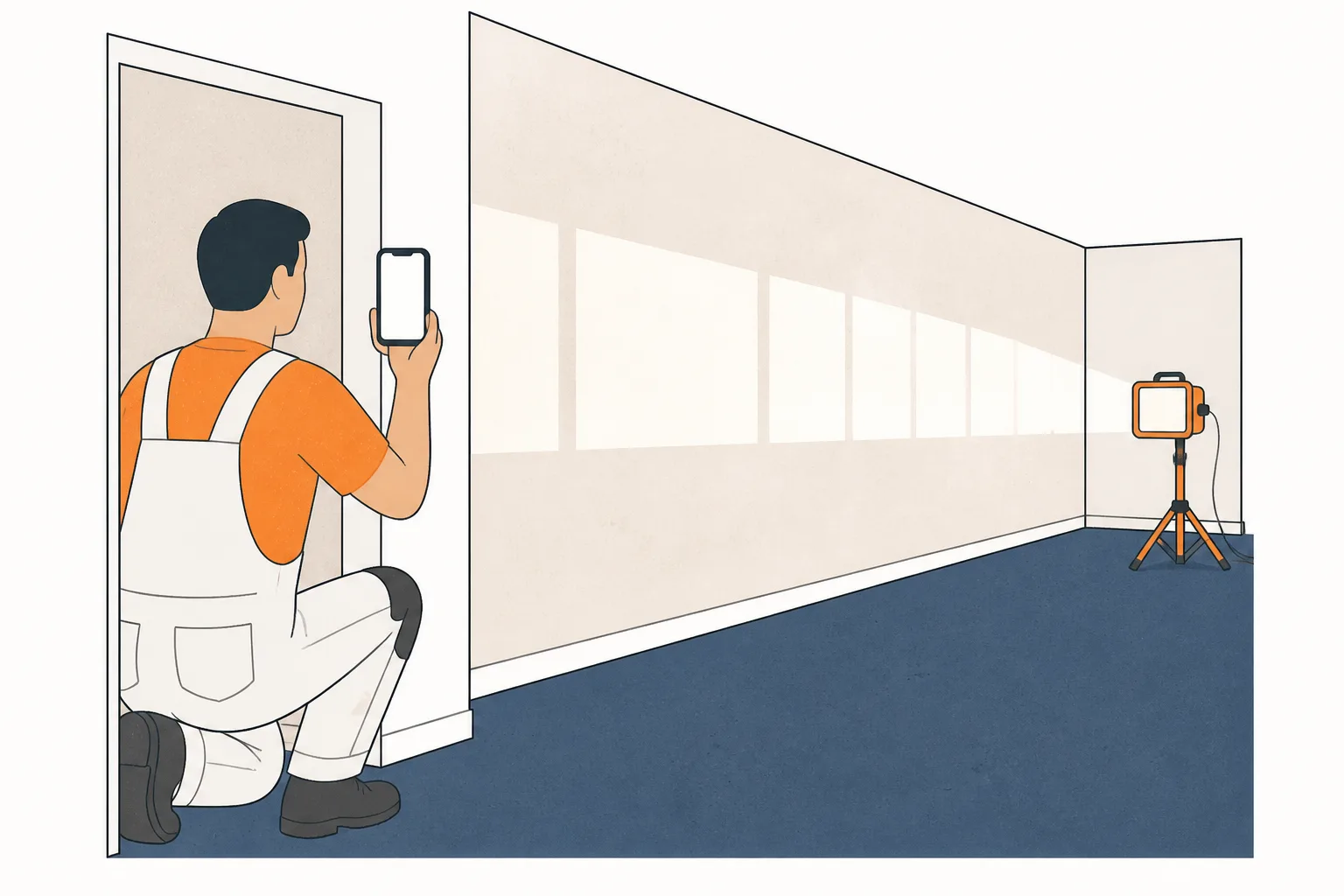
The way round it is light across the surface rather than at it. Stand at one end of the wall and shoot along it, with the light coming from the far end — a window, low sun through a doorway, a work lamp stood on the floor. Raking light is how you check your own work with a torch at four o'clock, and it is the same trick that makes a surface visible to a camera. The other shot worth learning is the reflection: photograph the window reflected in the skim rather than the wall itself. On good work its edge runs straight and unbroken; on bad work it ripples, and anybody can see that without being told.
That still only gets you a wall. What sells is the pair, because a finished wall only reads as proof beside what it was. The before shot wants taking in the first ten minutes, before the sheets go down, from a spot you can find again — the doorway with your back to the frame is nearly always the answer. Take the after from there, with the phone the same way round. A portrait before and a landscape after cannot be put beside each other.
The strongest pairs are of things a homeowner already has and already hates: an artex ceiling, a wall of blown plaster tapped off back to the brick, a ceiling with a crack and a stain at one end. Then take the middle picture, which almost nobody takes — beads on the angles, scrim on the joints, the scratch coat. That is the half of the job they pay for and never see again, and once you have gone nobody can check it.
Caption each set in one line: what it was, what you did, the town, and how long you were there. "Artex ceiling overboarded and skimmed, three-bed semi, Wakefield, one day." The timescale answers what they were too polite to ask.
- Turn the flash off and stay off the ultra-wide lens: one kills the shadows you need, the other bows the line you are selling.
- Wait until it has gone off to one even colour. Fresh plaster dries patchy and photographs as a damp stain.
- Ask before you publish the inside of somebody's house, and check what else is in the frame.
Dust, drying, and what nobody warns a customer about
Domestic plastering has two arguments built into it, and both are avoidable in writing, before you ever come out to price the job.
The first is mess. Somebody who has never had a plasterer in does not know what is about to happen: that mixing needs water and a plug and somewhere it can go everywhere, that whitening finds rooms you never entered, that the hall carpet will have a path down it. Write down what you sheet, what you want them to move, where you mix, and where the washing out goes — never the kitchen sink, where it sets in the trap.
The second is drying, and it is what gets plasterers blamed for other people's paint. A fresh skim is not a painted wall in waiting. It changes colour over days as the water leaves it, and the patches by the beads go last. Full-strength emulsion on it too early will not stick, and the person who did that on Saturday rings you on Monday about your plaster.
Write your own timings rather than copying somebody else's, because the honest answer depends on how thick it went on, the background, whether the windows open and what the weather has done. What belongs on the site is the shape of it: longer than people expect, one even colour all over before anything goes near it, a watered-down mist coat first, and no fan heater pointed at new work, which dries the face before the back. Then give the number you tell people on the job.

Skimming over artex, and the question underneath it
This is the most common thing a domestic customer wants to ask a plasterer, and it arrives sounding simple. Can you skim over my artex ceiling. Answering it properly on the site is worth more than anything else you will write there.
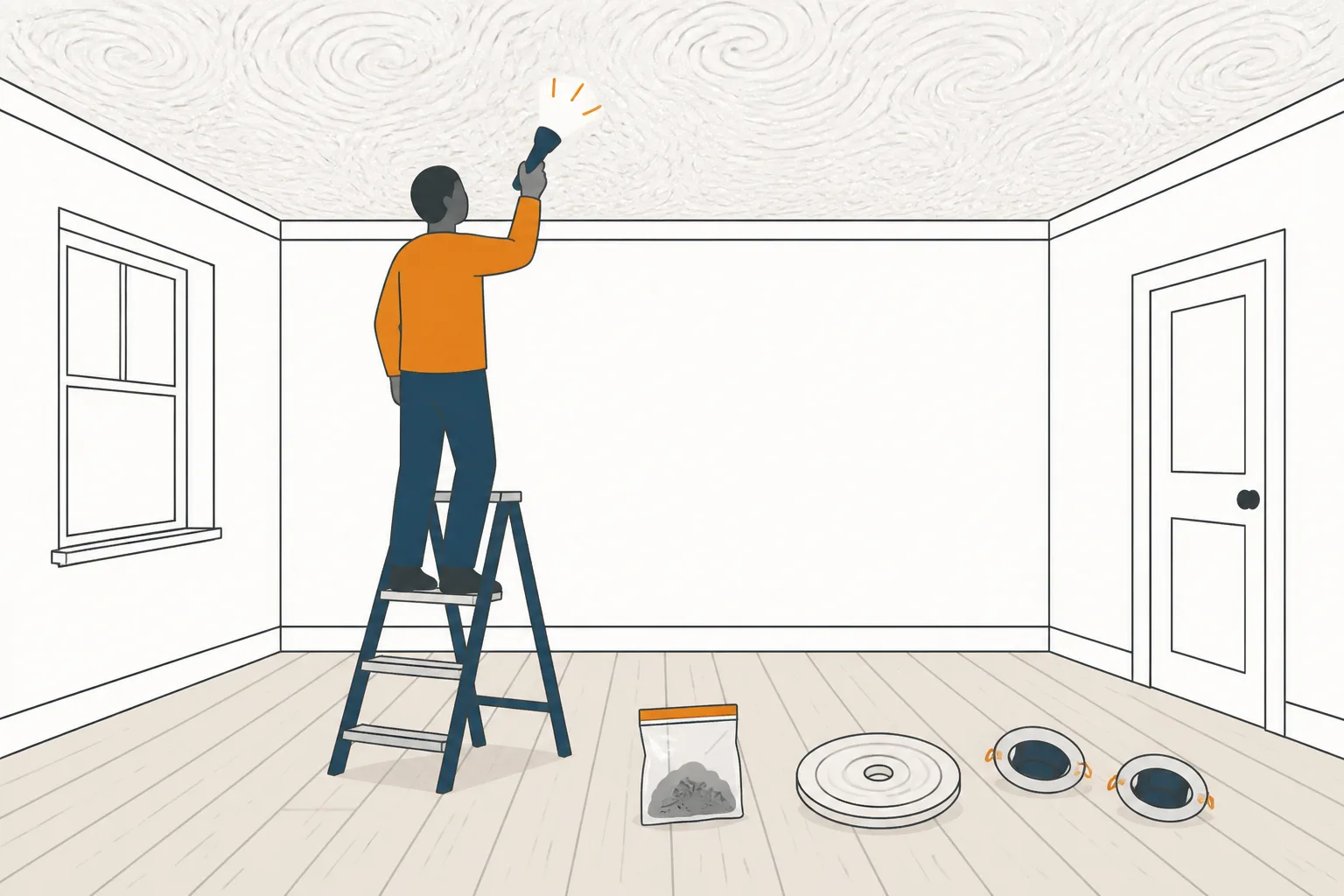
Asbestos comes first. Textured coatings were among the last common building products in this country to contain it, and asbestos was not completely banned in the UK until 1999. The rule the trade works to is that a textured coating in a house decorated before 2000 is treated as containing asbestos until a test says otherwise. That is not something to be vague about in writing.
So say what you do about it. If you sample and test, say who does it and roughly what it adds. If you will skim over an intact coating but will not scrape or sand one, put that in a sentence — it tells one sort of customer to ring you and tells another, politely, before they have taken your afternoon. If you do not touch pre-2000 textured coatings at all, write that down too.
The rest is craft, and customers are glad to have it explained. A flat or lightly stippled coating can often be knocked back, sealed and skimmed. A heavy swirl with real peaks in it is a different job, and overboarding is usually the better answer and always the dearer one, because the ceiling gains a layer and everything fixed to it has to move: the rose, the downlighters, the coving. A price that arrives with its reasons understood is a price people accept.
Note. Do not write that you can skim over any artex. Somebody will hold you to it on a ceiling that wanted boarding, and you will be back there on a Saturday.
Damp, and the job worth refusing in public
Every plasterer has been asked to skim a wall that should not be skimmed, and it comes with a sentence attached: just make it look right for now, I will sort the damp later. You lay on a good wall, it looks perfect for a few months, and then the salts come through the paint, and the name attached to that failure is not the leaking gutter's.
You are not a damp surveyor and the site should not imply that you are. What it should carry is what you do when you meet it: you look for where the water is coming from before you price anything, and you will not plaster over a wet wall until the cause is dealt with. A great deal of what gets called rising damp has a cause you can stand in the garden and point at — a bridged damp-proof course, a border built up above it, a gutter that has run down one corner for two winters. None of that is fixed by plaster.
Then say what you do take on. Whether you strip well above the tide mark, whether it is sand and cement with a waterproofer or a renovating plaster, and whether the wall wants drying time between the render and the finish, which makes it a two-visit job. Somebody who rings after reading that has accepted the shape of the work.
Which is the sentence this page has been building towards. Put the jobs you turn down on the site, in plain words: the wet wall with no fix in sight, the ceiling somebody has already had three goes at, the textured coating you were not allowed to test. It reads as confidence rather than as lost work, and every refusal made in public is an evening you do not spend driving out to say no.
What actually goes on the page
The ordinary things still have to be right. Name the work in the words people type: skimming, re-skim, overboarding, ceilings, patch repairs, dot and dab, stud walls, coving, rendering, external render, floor screed. Somebody told by a builder that they need a scratch coat and a top coat will type those words into a phone, and if they are nowhere on your site that person cannot find you.
On price, publish what moves it rather than a figure you cannot stand behind: skim over sound plaster or a re-board, how many internal and external angles, ceiling height, whether the room has been emptied, and access, because a terrace with nowhere to park is not a room off a driveway. If you publish numbers, publish your own and mark them as ranges. A price on a website is a promise somebody will read back to you.
And the contact form: the postcode, what the room is, and a photograph. That last one decides whether you price from the van or drive over, because plastering is one of the few trades where three pictures and a room size are enough for an honest range.
Note. Nothing on the site should say no job too small. Every plasterer's site says it, and small jobs are what you want filtered rather than advertised.
Common questions
- All my work comes from two builders. Should I bother with a site?
- Not this month, and it is worth saying so plainly. What is worth having is one page a surveyor or a builder's client can find when they look you up: trading name, towns, public liability with the figure, cards, and a number that answers. Build the rest when you want domestic work.
- How do I photograph a finished wall so it looks like anything?
- Shoot along the wall rather than at it, with the light coming from the far end, and turn the flash off. Then photograph the reflection of the window running across the skim: an unbroken straight edge to that reflection is the flatness, and anybody can see it.
- Should I put a price for skimming a room on the site?
- Put what changes it, and if you put figures make them your own: skim over sound plaster against a re-board, the number of angles, the ceiling height, whether the room is empty, and access. Do not lift a rate off another plasterer's page — it will be quoted back at you on a job it was never written for.
- Somebody wants their artex ceiling skimmed. What should the site say?
- That a textured coating in a house decorated before 2000 is treated as containing asbestos until a test says otherwise, and then exactly what you do about it: test, skim without disturbing it, or decline. Then the practical half — light textures can often be sealed and skimmed, heavy ones usually want overboarding.
- Does rendering want a page of its own?
- Yes, and the reason is the customer rather than the trade. Somebody wanting a hall ceiling and somebody re-rendering the front of a house are at different points in a different decision, and the render reader wants the systems named.