Guide · 10 min read
Describe your business so the site writes itself
What to put in the box: your trade, your towns, the jobs you want, the jobs you do not. Weak and strong descriptions side by side.
What happens to the words you type
A builder that writes your site has read a great many plumbing websites. Left to itself it will produce something that sounds like a plumbing website — competent, tidy, and indistinguishable from the other forty in your town. Whether it sounds like yours depends entirely on the sentences you hand it.
Every concrete detail you put in comes back out as something structural. A town name becomes a page title. A named job becomes a heading and a section. A sentence about who your customers are changes the vocabulary of every paragraph on the site. Vague words have nowhere to go, so they come back as filler: quality workmanship, competitive prices, no job too small.
The useful shift is to stop asking what you should say about your business and start asking what someone would need to know before they rang you. You already answer that question five times a week on the phone. Write down what you say.
Note. Specific in, specific out. There is no clever phrasing that makes a vague description produce a sharp website.

The six things worth saying
Six pieces of information do nearly all the work. You can write them in any order, in one paragraph, in the way you would say them out loud to somebody in a van. There is no format, no word limit, and nothing to be gained by trying to sound professional.
If you only have a minute, do the first three. Trade, towns and the jobs you want more of will get you a site that is broadly right. The last three are what stop it being broadly right and start it being recognisably yours.
- Your trade, said plainly. "Domestic electrician", not "electrical solutions provider".
- The towns and villages you cover, named. Not "the North West" — Stockport, Cheadle, Bramhall, Poynton.
- The jobs you want more of, in the words a customer would use for them.
- The jobs you do not want, so they never make it onto the page.
- Who you work for — homeowners, landlords, letting agents, builders, commercial sites.
- How you want to sound, plus one true thing a competitor could not copy.
Name jobs, not categories
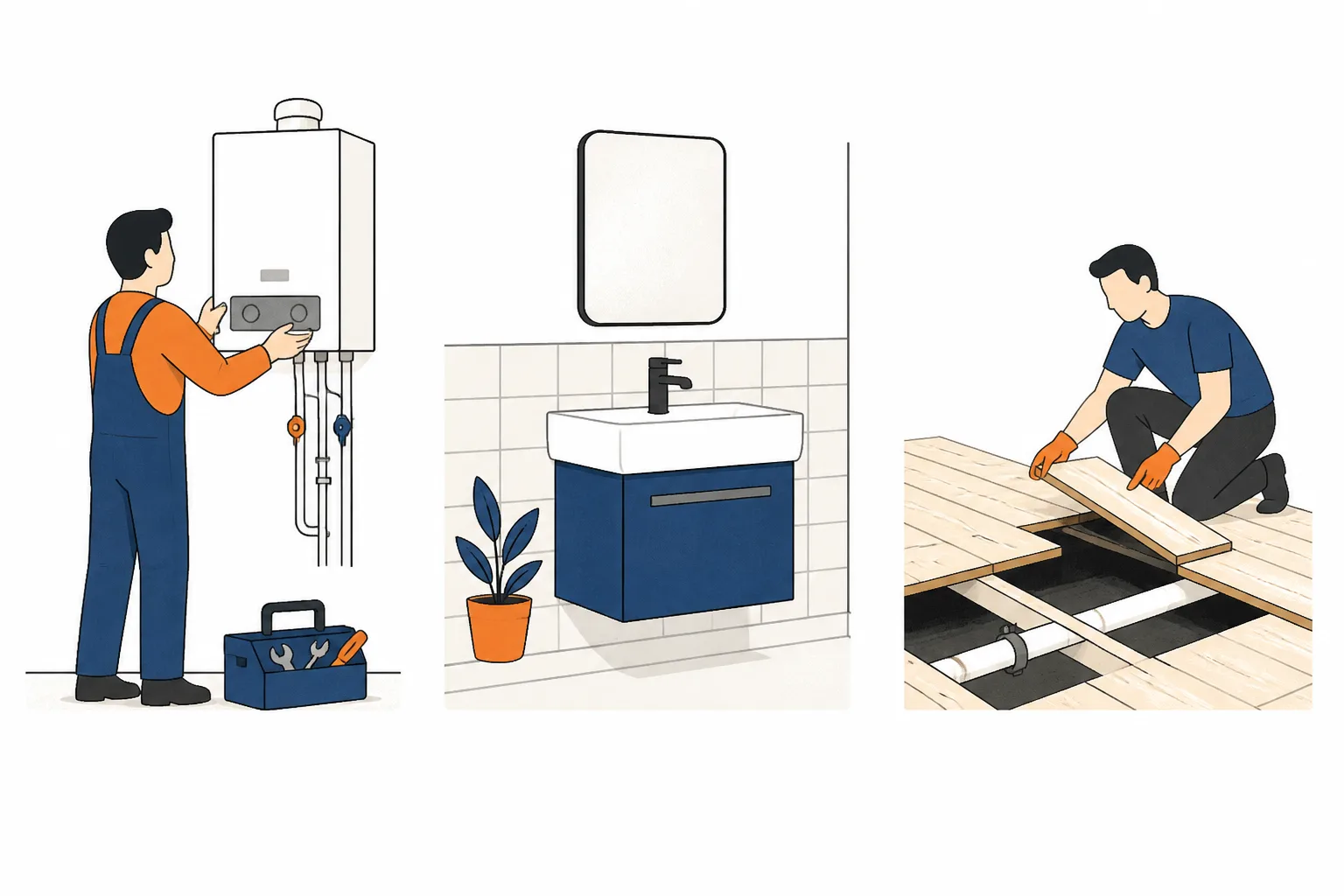
The single biggest improvement most people can make is to stop naming their trade and start naming their jobs. "Plumbing and heating" is a category. "Combi boiler swaps, bathroom refits, and leaks under a solid floor" is three services, three headings, and three things somebody might be typing into a phone tonight.
Use the customer's words rather than the trade's. A homeowner does not search for a consumer unit upgrade. She searches for a fuse box replacement, because that is what her mortgage adviser called it. Put both on the page if you like, but lead with hers. The same goes for damp proofing versus rising damp, and for soffits and fascias versus the bit of the roof that has gone green.
Then weight them. Say which jobs you actually want more of and which you merely tolerate, because that ordering decides what goes at the top of the services page and what gets a single line near the bottom. If rewires pay your mortgage and fault-finding call-outs eat your Tuesdays, the site should not treat those two equally just because you do both.
- "Boiler replacements — Worcester and Vaillant mostly, usually a day and a half."
- "Full rewires in 1930s semis. That is the work I want more of."
- "EICRs for landlords, certificate emailed within 24 hours."
- "Flat roof repairs and full felt replacements. No pitched tiling."
- "End of tenancy cleans for letting agents in Didsbury and Chorlton."
- "Clutch and cambelt work. I am not an MOT station."
Say what you do not do
The half of the description almost everyone leaves out is the exclusions, and it is the half that saves the most time. A website that does not rule anything out is quietly advertising for every job in your trade, including the ones you turn down. Each of those arrives as a call you have to take, assess and politely refuse, usually while you are on your knees under somebody's sink.
Ruling work out does not make you look small. It reads as somebody who knows what he is good at, which is the opposite of how it feels to write. "I do not do commercial" tells a homeowner she is the main event rather than the filler between contracts. "No emergency call-outs after 9pm" tells a reader you are a person with a family, which is not a weakness in this trade.
Distance is worth being blunt about too, because it is the most common source of wasted calls. Give a radius or a boundary you can live with — the far side of the M60, anything within about thirty minutes of Taunton — and let the site turn people away before they turn into a forty-minute quote you were never going to win.
Note. A minimum charge does the same job silently. "Minimum call-out £80" filters more wrong callers than any amount of careful wording.

Who you serve, and how you want to sound
Who you work for changes the copy more than people expect. A site aimed at landlords talks about certificates, turnaround, access and keys. The same trade aimed at homeowners talks about mess, timing, whether you can work around the school run, and what happens to the dog. Same electrician, two different websites, and the difference is one sentence in the description.
Tone is the other place where a few words do a lot. "Straight-talking, no jargon, no sales patter" produces different sentences to "gentle and reassuring, a lot of my customers are elderly and nervous about being ripped off". Both are honest. Neither is a marketing decision — it is a description of how you already talk to people, and the site should not sound like a different bloke turning up at the door.
The last piece is one true detail nobody else could put on their site. Not a claim, a fact. Twenty-two years on the tools. Second generation, my dad started it in 1987. I text when I am on my way. I take my boots off. Ex-British Gas. I am the only one who answers the phone, so you are never explaining it twice. One of those is worth more than a page of adjectives, because it cannot be copied by the firm down the road.

Weak and strong, side by side
Here is a description that produces a forgettable site. "We are a family-run plumbing company offering a wide range of plumbing services to both domestic and commercial customers across the region. Quality workmanship, competitive prices, no job too small." Nothing in it is untrue. Nothing in it is usable either — there is no town to put in a page title, no job to build a section around, and no reason to ring this plumber rather than the next one.
Here is the same business described in a way a builder can actually work with. "Two-man plumbing and heating firm in Chorley, twenty years in, Gas Safe. We cover Chorley, Leyland, Euxton and Adlington. What I want more of is boiler swaps and full bathroom refits — those are the jobs worth doing. I will still sort leaks and radiators for regulars, but I do not want midnight call-outs and I do not do commercial. Most customers are homeowners in their forties and fifties who are nervous about being overcharged. Talk to them straight, no sales patter, and put the call-out fee on the page so nobody has to ask."
That is under a hundred words and it settles almost everything: which pages exist, what the headings say, the order of the services, which towns go in the titles, the tone of every sentence, and the fact that a price is visible before anyone picks up the phone. It took about ninety seconds to type. The first version took about the same and decided nothing.
| What people tend to write | What works better |
|---|---|
| "Professional plumbing services in the North West" | "Domestic plumber covering Bolton, Bury and Radcliffe" |
| "All aspects of electrical work undertaken" | "Rewires and fuse box replacements, mainly older houses" |
| "We pride ourselves on quality workmanship" | "Twelve years on the tools, ex-British Gas, mostly boilers" |
| "Free quotes, competitive prices" | "Call-out £65, quotes for full jobs are free" |
| "Serving customers throughout Kent" | "Maidstone, Aylesford, Bearsted and the villages off the M20" |
| "Friendly and reliable service" | "I text when I am on my way and I clear up after myself" |
| "No job too small" | "Minimum charge £80. No commercial, no new builds" |
Fixing it once you can see it
You will not get it right in one go and you do not need to. It is far easier to react to a site sitting in front of you than to describe one that does not exist yet, which is why the first draft is worth generating before you have finished thinking. Read it as a customer would, on a phone, and notice what makes you wince.
Then say what is wrong in exactly the plain way you would say it to a person. Not "optimise the hero section" — "this sounds like a call centre, I am one bloke with a van". Not "add local SEO" — "put Radcliffe and Whitefield in, I get a lot of work there". The correction is the same kind of sentence as the original description, which is the point: the site stays editable in the language you already speak, so it keeps up as the business changes instead of freezing on the day it launched.
One trap worth avoiding. If the whole thing reads slightly wrong, do not fix one paragraph. Something general is off — usually the tone or who it thinks it is talking to — and patching a sentence at a time will leave you with a site that argues with itself. Say the general thing and let it all move together.
- "Too formal. Write it like I talk — short sentences, no sales words."
- "Move bathroom refits to the top. That is the work I want."
- "Take out commercial. I do not do it and I do not want the calls."
- "Add Ramsbottom and Tottington to the areas."
- "Put my name and my face on the home page. People ring people."
- "The prices read as certain. Make it clear they are ranges."
Common questions
- How long should the description be?
- Somewhere between three sentences and a short paragraph is plenty — the Chorley example above is under a hundred words. Length is not what makes it work; specifics are. Two sentences naming real towns and real jobs beat a page of general description.
- Do I need to put keywords in it?
- No. Write the way a customer would ask for the work and the keywords take care of themselves, because those are the same words. Deliberately stuffing in phrases like "plumber Bolton plumbing services Bolton" makes the copy read badly and buys you nothing.
- I do a bit of everything. What do I put?
- Put everything you do, then say which two or three you want more of and which you would rather not be rung about. Most trades are like this, and the ordering is the useful part — it decides what goes at the top of the page and what gets a single line at the bottom.
- Does my spelling and grammar matter?
- Not at all. Type it the way you would say it, punctuation and all, and it will still come out as clean copy. Nobody sees what you wrote in the box.
- What if I would rather not put prices in?
- You do not have to, but say so explicitly rather than leaving it out — "do not put prices on, every job is different" gets you a site that handles the question honestly. A call-out fee or a rough range usually earns more calls than it loses, because the people it turns away were shopping on price anyway.