Choosing a no-code route · 7 min read
How to build an app without coding: choose your route
Compare four ways to build an app without coding: an AI prompt builder, a visual no-code platform, a data tool, or a developer-assisted route.
Choose from the job, not the platform demo
Building without coding is not one method. An AI prompt builder, a visual no-code platform, a spreadsheet-backed tool and a developer working from generated code can all produce something called an app. They suit different jobs and leave you with different kinds of control.
Begin with the repeated job the app must handle. Who starts it, what do they enter, what must be saved, who may see it, and what proves it finished? A customer choosing a service and receiving a confirmed time is specific enough to compare tools against. 'An app for my business' is not.
Then mark the difficult parts. Accounts, permissions, payments, live stock, offline work, notifications and connections to existing systems matter more to the choice than the number of screens. A polished demo tells you how the easy path looks. Your list tells you whether the awkward path can work.
The four practical routes
There is no best no-code platform in the abstract. There is a route whose compromises fit the app you are making. Use this table to narrow the field before you spend a week learning somebody's editor.
| Route | Usually strongest for | Watch carefully |
|---|---|---|
| AI prompt builder | A fast working first version, custom screens and conversational changes | Whether data, permissions and external connections are genuinely working rather than drawn |
| Visual no-code platform | Repeatable workflows you want to control through a canvas and settings | Learning curve, platform limits and what can leave with you |
| Spreadsheet or database tool | Internal lists, approvals, trackers and lightweight team operations | Customer-facing design, complex permissions and growth beyond the original data model |
| Developer-assisted route | Unusual integrations, native features, sensitive rules or a product expected to grow | A larger budget, a clear handover and who maintains it afterwards |
Note. A route can change later, but moving saved data, accounts and payments is much harder than redrawing a screen. Compare the hard parts before the colours.
Choose an AI prompt builder for speed and a custom first draft
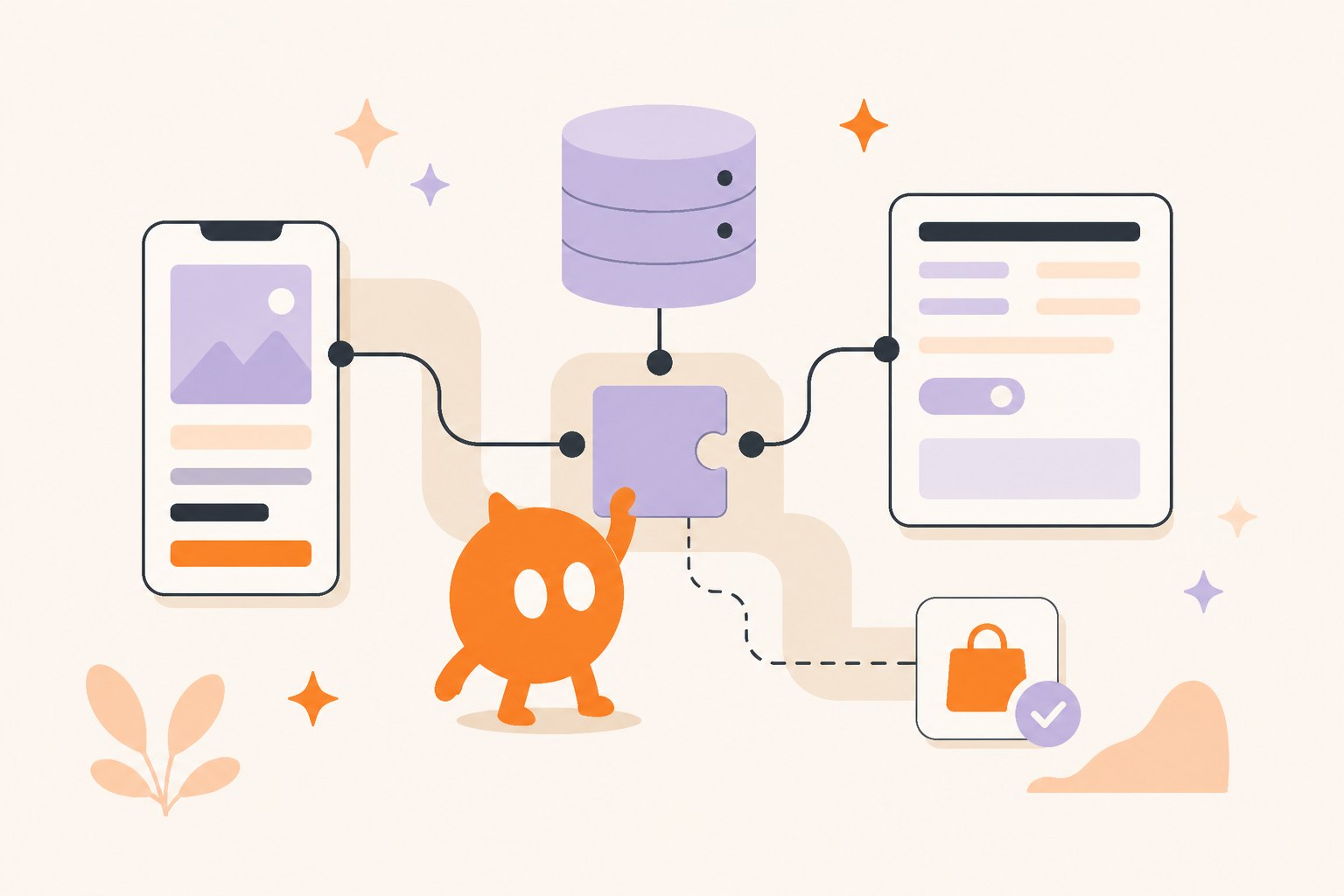
An AI prompt builder suits somebody who can describe the outcome more easily than they can assemble a workflow on a canvas. You explain the app, inspect a working draft and ask for changes in ordinary language. It is often the quickest route to a custom-looking web app and the easiest way to explore an idea before every detail is settled.
The important distinction is between generated screens and a working system. A sign-in page does not prove accounts are protected. A payment button does not prove money reaches the right account. A dashboard full of figures does not prove the figures come from real records. Ask the builder to show what is connected, then test it with two users and deliberately failed actions.
Choose this route when speed, visual freedom and conversational editing matter, and when you are willing to verify the underlying behaviour. Check whether you can export the files and whether the database, authentication and service accounts travel with that export or remain separate.
Choose visual no-code when you want to own the workflow
A visual no-code platform exposes the parts of the app as screens, data collections, triggers and actions. It takes longer to learn than describing the result in a prompt, but the rules are visible and repeatable. That can be valuable when the person building the app will also maintain it every week.
This route works well for forms, directories, membership areas and operational workflows whose logic fits the platform's own model. It is less comfortable when the design must be highly distinctive or the app needs a connection the platform does not support. Custom code blocks can fill a gap, but once every important step depends on one, the project is no longer honestly no-code.
Before choosing, build one complete journey in a trial account. Include the permission rule and external connection you expect to be hardest. Also inspect the paid tier that contains those features: the free plan proves the editor opens, not what the real app will cost.

Choose a spreadsheet or database tool for internal work
Sometimes the app is really a shared set of records with a safer front door. A job tracker, stock list, approval queue, inspection log or simple CRM can often be built fastest in a tool that starts from tables and gives each person a controlled view.
This route is practical when the team already thinks in rows, statuses and owners. Imports are straightforward, changes are easy to audit and the first useful screen may take hours rather than days. It is usually a weaker fit for a public customer product where brand, navigation and a calm phone experience carry as much weight as the records.
Test permissions with separate accounts rather than relying on filtered views. Hiding a column on one screen is not the same as preventing that user from reading its data. Check record limits, automation limits, file storage and the cost of adding every person who needs access.
Use a developer-assisted route when the edge cases are the product
No-code is a way to avoid writing every line yourself, not a promise that every app should exclude a developer. If the central value depends on a specialist integration, complicated access rules, regulated data, reliable offline work or deep phone features, paying for help early can be cheaper than forcing the idea through the wrong platform.
A useful middle route is to build the flow and screens with an AI or no-code tool, test the idea, then hand an export and a written list of rules to a developer. They begin with evidence instead of a blank brief. Agree who owns the source, domain, data and service accounts, and make the handover include instructions for running and updating the app.
Native iOS or Android work belongs here when you genuinely need app-store distribution, background activity, dependable offline behaviour or device features a browser cannot provide. A web app is the better first choice for many portals, booking tools, dashboards and calculators because it opens from a link and updates without an app-store release.

Run the same trial before you commit
Shortlist two routes and give each the same test. Build the smallest complete journey, open it on a phone, use two accounts, enter a wrong value and export whatever the platform says you own. This reveals more than comparing feature grids whose rows use the same words for different things.
- Build the central journey from its first screen to a saved result.
- Check the empty, loading, success and failure states.
- Sign in as two different people and try to cross the permission boundary.
- Test the hardest payment, calendar, email or data connection with a non-production account.
- Download the files and data, then write down what did not come with them.
- Price the version you would actually launch, including users, storage and automation runs.
Tip. Choose the route that completes the difficult test with the fewest hidden assumptions. The editor you enjoy most matters, but the app people can rely on matters more.

Common questions
- Can I build an app without coding?
- Yes. AI prompt builders, visual no-code platforms and data tools can all produce useful web apps without you writing the code yourself. You still need to choose the workflow, test permissions and connections, and understand what you own.
- What is the best no-code app builder?
- The best fit depends on the difficult part of your app. Use an AI prompt builder for a fast custom draft, visual no-code for hands-on workflow control, a data tool for internal records, and developer help for unusual integrations, native features or sensitive rules.
- Can a no-code builder make a native mobile app?
- Some platforms produce native or wrapped mobile apps, but many build web apps that run in a browser. Check app-store packaging, offline behaviour, notifications and device access directly. Do not assume a phone-shaped preview means a native iOS or Android app.
- Will I own an app made with a no-code platform?
- It depends on the platform and the services behind the app. Check whether you control the domain, source files, data export, database, payment account and other service accounts. A code export may not include the live data or authentication system.