Agents · 10 min read
What training an agent changes
Why a taught line, a switched-on tool or a connected payment link can leave the built site looking identical, and what actually reaches a build.
You trained your agent and the build ignored it
Training is a standing brief, not an upgrade to the product. Everything you teach, switch on and connect is held on that one agent, and it reaches a website only on the turns that agent builds. A turn sent while the builder is Grafter sends exactly the request it has always sent: no brief, no directives, no tools, no connections.
Who builds is a separate choice from who you have been editing. Beside the box you type into there is a small picker showing a face and a name. Until you change it, that name is Grafter — including in the minute after an hour of training. That separation is on purpose: switching which agent you are training must not quietly switch who builds your next site, because one of those two acts costs money.
- Open the site you want built that way.
- Press the name beside the box you type into, and choose your agent from the list.
- Send the turn. Anything you had already typed is untouched — the picker only decides who reads it.
Tip. If that name says Grafter, the turn you are about to send ignores every skill, every tool, every connection and every line you have taught. This is the single most common reason a trained agent seems to have changed nothing.
Note. The choice is stored on the site rather than in your browser, so it only has to be made once per site. Every later turn on that site is built by the same agent until you change it back. A second site starts on Grafter again.
What actually carries across
When your agent is the builder, six things travel with the turn.
- Its name, so the build knows whose work this is.
- Every skill switched on, sent as instructions to apply to every file it writes.
- Every tool switched on, sent as a line saying to build that thing into the site.
- Anything connected — a payment link, a booking link — attached to the tool it belongs to.
- The brief: every line in the rail of notes beside the training chat, word for word, up to two thousand characters of it.
- The eight most recent entries from the learned log, which is a different list from the rail. There is a section on that below.
Note. Nothing else travels. The conversation you had while training does not go with the build — only the lines that filed into the notes rail do.
Works on is not the same as who builds
There are two links between an agent and a site, and neither one sets the other.
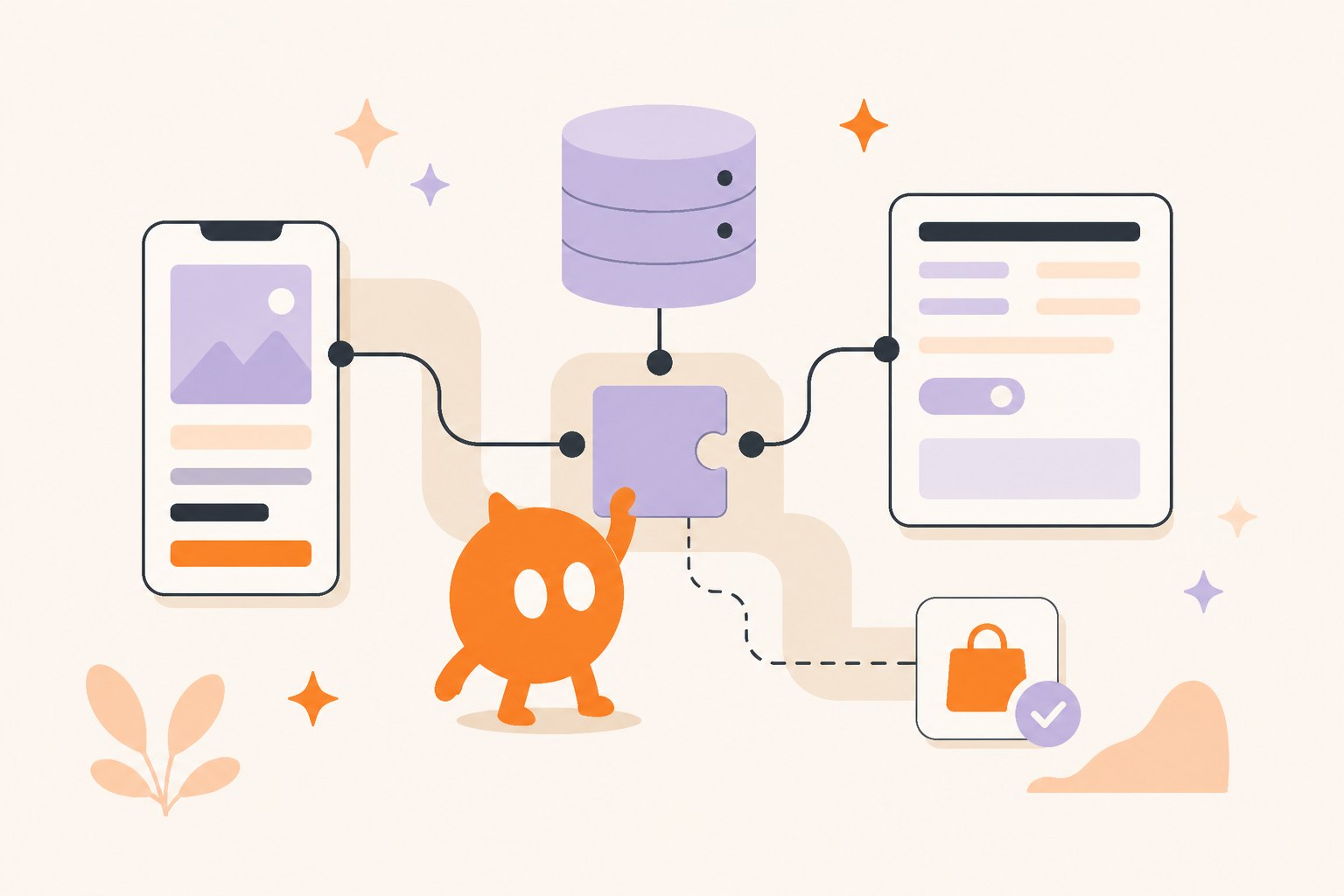
Works on, in the agent's panel on the training screen, is the site that agent may build against on its own. It is the only site it can change when you ask it to in its own chat, and it is the site already chosen when you press build on one of its saved plans. Who builds when you type is the picker beside the box. Setting one has never set the other, and nothing on either screen says so.
The result is a silence in both directions. Set Works on and nothing about your own turns changes. Choose the agent beside the box and its panel still has nothing linked, so asking it in its own chat to update your site comes back saying no site is linked to it yet.
- To have the agent build when you type: open the site and choose the agent beside the box.
- To have the agent change a site from its own chat: set Works on to that site in its panel.
- If you want both, set both. They are stored separately and neither is a default for the other.

Switching a tool on does not touch the site on your screen
A skill or a tool is a sentence added to the next build. It is not an action on a site that already exists. Switch on a gallery, reviews and opening hours, save, then go and look at your website: it is unchanged. Nothing in the agent's panels edits a site, and nothing in them spends a build turn either.
The panel describes these as things your agent builds into every site, which is true of every site it builds from that moment on. It does not say a build has to happen for anything to appear, and that is our wording rather than your misreading.
- Open the site.
- Check that your agent is the name beside the box.
- Send one short turn. Asking it to add the sections it is set up for is enough.
Note. Switching skills and tools on and off is free, and so is connecting an account, changing Works on, or removing a line from the brief. Only sending a message costs credits.
A payment link on your agent is not payments on your account
There are two separate Stripe connections in Grafter and they do different jobs.
Connecting Stripe to an agent stores one payment link and tells the build to point every buy, pay and deposit button straight at it. That is a link and nothing more. It does not make your account able to take money.
Payments, on your dashboard, is the other one: the account-level connection that lets a site charge a card and have the money arrive with you. Until that is connected, every build is told plainly that this site cannot take payments yet, and told not to invent a payment address or write a placeholder for one. The same instructions also forbid using any web address that is not already in the site's files — which a link you have just pasted into an agent is not.
So when you have connected a link to an agent but not connected Payments, one request carries both your link and a rule against using it. Which of the two the build follows is not decided anywhere, and that is why the buttons come back inconsistent: sometimes wired to your link, sometimes a note saying payments are not set up. This is our fault rather than yours, and it is a bug rather than a preference.
- For a real checkout, connect Payments on your dashboard. That works with or without an agent, and there is no key to put in a file.
- If you would rather use your own payment link, connect it to the agent and then read the buy buttons on the built site before you publish it.
- Do not expect a single consistent answer from doing both at once yet.
Tip. A link out of the page — a checkout, a booking page, a message app — cannot open in the preview or on a share link. Both render your site sealed off from the page around it, so clicking through does nothing there. That is expected rather than a broken build, and the published site is where those get tested.
Note. The Stripe store tool asks for a pricing table, and a pricing table needs a script loaded from outside the site. The instructions that go out with every build refuse outside scripts outright, so that one tends to come back as ordinary buttons however carefully the code was pasted in.
The notes rail and the learned log are two different lists
Beside the training chat there is a rail of notes. That is the brief, and teaching is what fills it. Underneath, folded, there is a panel headed with your agent's name and what it has learned. That is a different list from a different source, and it is the one people expect training to fill.
The learned log is written by building, not by talking. It only gains anything when a build turn, with that agent chosen beside the box, actually writes files. A turn that came back with a question instead of a site, a turn that failed, and a turn built as Grafter all add nothing. When a turn does count, at most two sentences are kept from what you wrote — the ones that read like a standing preference rather than a one-off instruction — so plenty of real builds add nothing either.
That is the empty panel after twenty training messages. It is working; it is simply not fed by the chat.
- The rail is your words: editable, each line removable, and all of it up to two thousand characters is spent on every build.
- The log is written for you from your build messages: at most two lines per build, the newest hundred kept, and only the newest eight ever reach a build.
- There is no way to remove a line from the log. That is a missing control rather than a hidden one.
Tip. Anything that must always hold — how you price, what you never sell, your brand colour — belongs in the brief as a taught line. The log is a memory of your habits, not a place to keep a rule, and a rule left there falls off the end after eight more lessons.
It said the brief is full
The brief is a fixed two thousand characters, which is roughly twenty to thirty taught lines. A line that would push it past that is refused whole rather than cut off part-way, and nothing is saved.
The turn has been paid for by the time that happens. You can read the line that would have been kept, but it is not stored anywhere, and teaching it again is another turn. The cost is taken before the room is checked, which is our fault and worth knowing before a long session rather than after one.
- Remove the lines in the rail that no longer describe how you work. Each chip carries its own remove control.
- Teach the new line again.
Note. Removing lines costs nothing. Pruning first is free; pruning afterwards costs a turn per line you have to re-teach.
A file your agent made has gone
When an agent makes you a file — a price list, a set of brand notes, a page of copy — it arrives in the conversation as a chip with a download button on it. That chip lasts as long as the tab does. The contents are never kept on our side: the saved conversation records that a file of that name was made, and nothing more.
So after a reload there is nothing to recover, and asking for it again is another paid turn. That is a gap rather than a decision we would defend.
- Download a made file the moment it appears.
- Better: connect a folder from the plus menu in the agent's chat before you ask, and every file it makes saves straight into that folder as it arrives.
Note. The folder option only appears in browsers that support it, which today means Chrome and Edge. In anything else the row is absent rather than broken, and the download button is the whole story.
Common questions
- Does training an agent make Grafter's own builds better?
- No. Everything is held on that one agent and is spent only on turns it builds. A turn built as Grafter is the same turn it would have been before the agent existed.
- I trained one agent. Do my others know what it knows?
- No. Skills, tools, connections, the brief and the learned log all belong to one agent, and there is no way to copy them across to another.
- Do I have to choose my agent again on every turn?
- No. Once you have sent a turn with it chosen, the site remembers. It is remembered per site, so a new site starts on Grafter until you choose again.
- I taught it something and the site changed nothing. Was the credit wasted?
- The teaching was not wasted if the line is now in the notes rail — it will be sent with every build that agent does from here on. If the rail is empty, nothing was stored, and that is worth telling us about from the contact page.
- Is anything lost while I work this out?
- No. A brief, its skills, its tools and its connections sit on the agent whether or not any site has ever used them, and a published site stays online throughout.